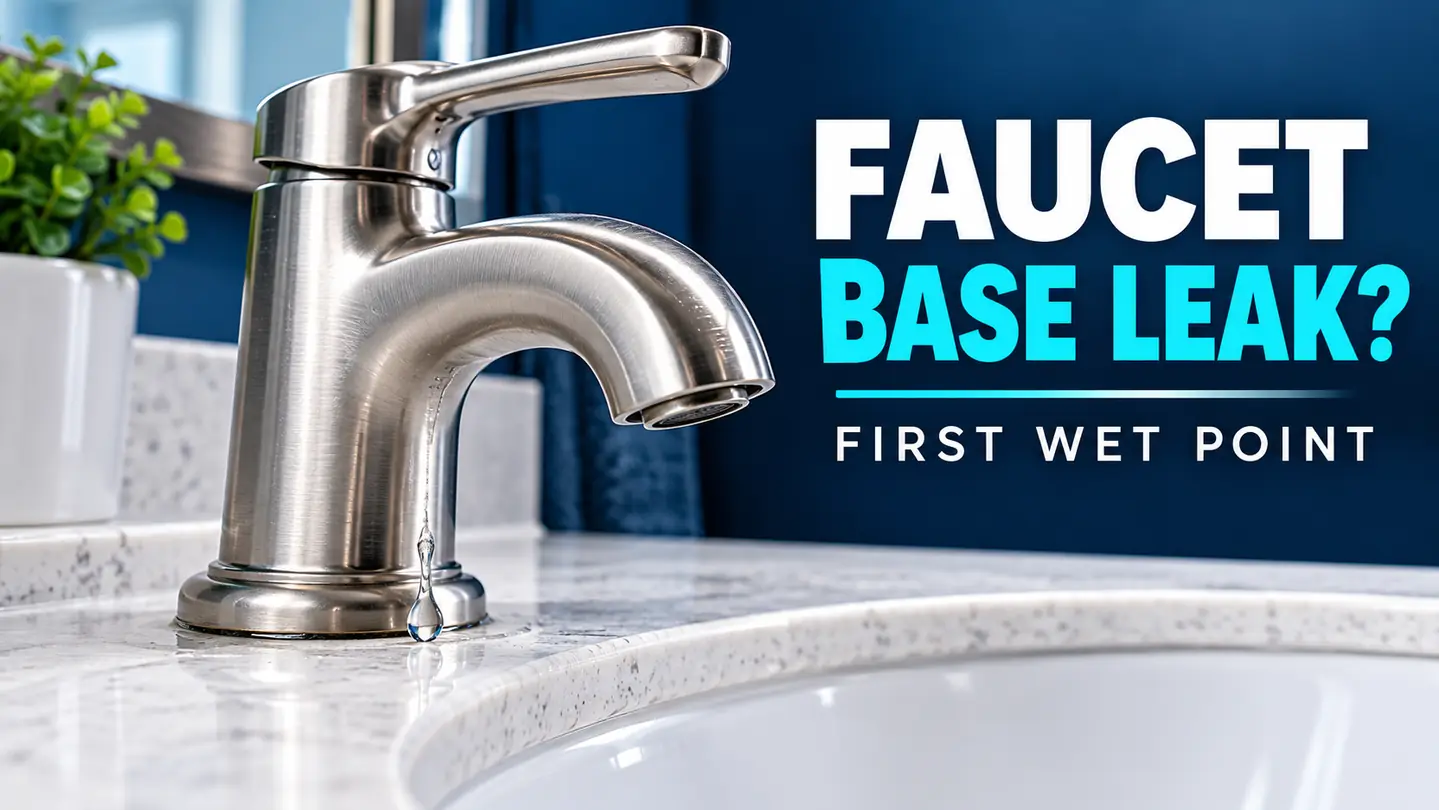
Quick answer: If water gathers around the base of a bathroom faucet only when it is on, it may be running down from the handle, appearing at the spout-base seal, or coming from a wet upper-deck connection. A puddle on the escutcheon (decorative baseplate) does not, by itself, identify a bad O-ring or cartridge. First distinguish above-counter water from under-vanity supply fittings, and record the earliest place a fresh drop becomes visible.
Exact scope: U.S. residential bathroom basin faucets with a single-handle or two-handle layout and visible spout-base/deck area. This article focuses on water around the faucet body or baseplate, not a dripping spout with the faucet fully off, a pop-up stopper that won’t close, or a kitchen faucet. Brand and model determine compatible parts; no hands-on product testing is claimed. Official Moen support reviewed October 30, 2026.
1. Stop conditions that take priority over identifying a seal
- Water flows into cabinet wiring, an outlet, or a powered bathroom device: keep clear and do not operate wet electrical items; obtain professional help.
- Water is spraying from a pressurized hose or shutoff: stop using the faucet and use an accessible identified shutoff only if safe. Do not attempt a cartridge or aerator diagnosis.
- Cabinet floor is swollen, paint is bubbling, or dampness continues between uses: report ongoing moisture; wiping a countertop does not establish that a hidden leak is gone.
- In a rented home: document the first wet point and inform the building manager. Don’t remove handles, loosen supply connections, or use sealants as a temporary concealment.
- Water has reached the floor below: stop fixture use and request qualified assessment; don’t repeatedly run the faucet to reproduce the leak.
2. A five-row first-wet-point comparison
| First wet location | Possible path to investigate | What you cannot conclude |
|---|---|---|
| At handle stem or handle cap | Handle-area leakage may run downward onto the escutcheon | That the spout-base O-ring is defective |
| Right at spout base when flowing | A spout-base seal or model-specific internal path is possible | That every faucet uses an identical cartridge or O-ring |
| On deck plate without a clear first drop | Splash from washing hands, handle runoff, or another fixture path | That the plate itself is a leak source |
| Under-counter valve hose or central spout connector | Potential under-deck supply/transfer hose leak | That a surface-deck seal can fix it |
| At drain tailpiece or pop-up pivot rod | Gravity-drain or stopper assembly issue, separate from water-supply faucet body | That a handle cartridge is responsible |
Why the chronology matters: A handle leak can run across the counter and pool around the faucet base. Conversely, an intermittent hose leak beneath the deck may leave the countertop dry. “It leaks at the base” is not specific enough for repair or part selection.
3. The manufacturer separates base, handle, and under-deck symptoms
Moen’s Bathroom Faucet: Leaking Around the Base guide specifically warns that water from a handle can accumulate at the base and mimic a spout-base leak. For certain faucet styles it describes aerator service, cartridge replacement, or O-rings as model-specific follow-up procedures. Those possibilities are not universal part recommendations and should not be attempted as a blind repair.
Moen also distinguishes above-deck leakage from leakage under the sink base. Its support material classifies persistent shutoff or supply hose leaks separately from intermittent transfer-hose leaks between handle valves and spout. Different generations of faucet hardware use different connector families, reinforcing why identifying the model comes before ordering a replacement.
A separate Moen spout-end drip FAQ covers a different symptom: water emerging from the outlet after the faucet is off. A spout-end drip and a wet escutcheon are not interchangeable diagnoses.
4. The safe observation method: no dismantling
- Before use: if water is already escaping or cabinet materials are wet, do not run the tap again; take photographs from a dry position and seek repair.
- If the area is dry and no damage is present: record what household members already noticed during normal use—where droplets first appeared and when. You do not need a prolonged flow test to make a useful report.
- Look from above: note the handle rim, spout neck, baseplate edge, backsplash, and sink rim as distinct wet locations.
- Look from outside the vanity: only if safe and dry, note whether supply or transfer fittings are visibly wet without reaching inside or touching connections.
- Note faucet type: single handle, centerset two-handle, mini-widespread, widespread, or unknown. A photograph is more useful than guessing a model.
- Stop if new moisture is observed: do not keep cycling the handle, remove the aerator for a leak trial, or tighten connectors.
5. Original decision matrix: three similar photos, three different routes
| Illustrative case | Observation | What a careful handoff says |
|---|---|---|
| A — wet escutcheon near handle | First visible bead is at handle joint while faucet runs; baseplate wet afterward | Possible handle-area leak; model identification before component selection |
| B — water around spout base | First visible bead is around spout neck; handle area appears dry | Possible spout-base leak; check model-specific Moen/other manufacturer instructions |
| C — wet underside but dry counter | A supply/transfer line below deck is damp, with no above-deck water observed | Potential supply/transfer hose; stop use and request appropriate qualified repair |
These three cases are constructed examples for decision training, not firsthand test results or a ranking of the most frequent failures. In a real bathroom, water can travel across surfaces and the first observed droplet may not be the origin.
6. What to tell the technician
“Bathroom sink faucet, [single/two] handle, brand/model [if known]. Water first appeared at [handle / spout base / plate / under-deck hose / unknown]. It occurred [when faucet operated / between uses / unknown] and the vanity cabinet is [dry / wet]. I did not remove parts or tighten connections. Please distinguish above-deck handle or spout-base leakage from under-deck transfer/supply fittings before recommending parts.”
7. FAQ: the three fastest mistakes to avoid
Can I simply caulk around the faucet base? No. Caulk does not correct a leaking cartridge, seal, or pressurized transfer hose and could conceal recurring water. Find the source before cosmetic sealing.
Would every wet base be repaired by replacing an O-ring? No. Moen’s manufacturer guidance makes different recommendations for different faucet designs. Identify the exact model and symptom before choosing a part.
What if the cabinet is wet at the pop-up drain? That’s a different path. See the pop-up drain pivot-rod and P-trap guide instead of treating it as a faucet-base leak.
Is an off-position drip from the faucet outlet the same as a base leak? No. Outlet drips after the handle closes point to a different mechanism that should be discussed with model-specific guidance.
Related leak guides and primary source links
For help recording observations, use the Home Leak Triage Worksheet. See all water-leak guides and the site’s source-verification methodology.
- Moen, Bathroom Faucet: Leaking Around the Base of the Faucet.
- Moen, Bathroom Faucet: Leaking Under the Sink Base.
- Moen, Fixture leaks from the end of the spout.
- U.S. EPA WaterSense, Fix a Leak Week.