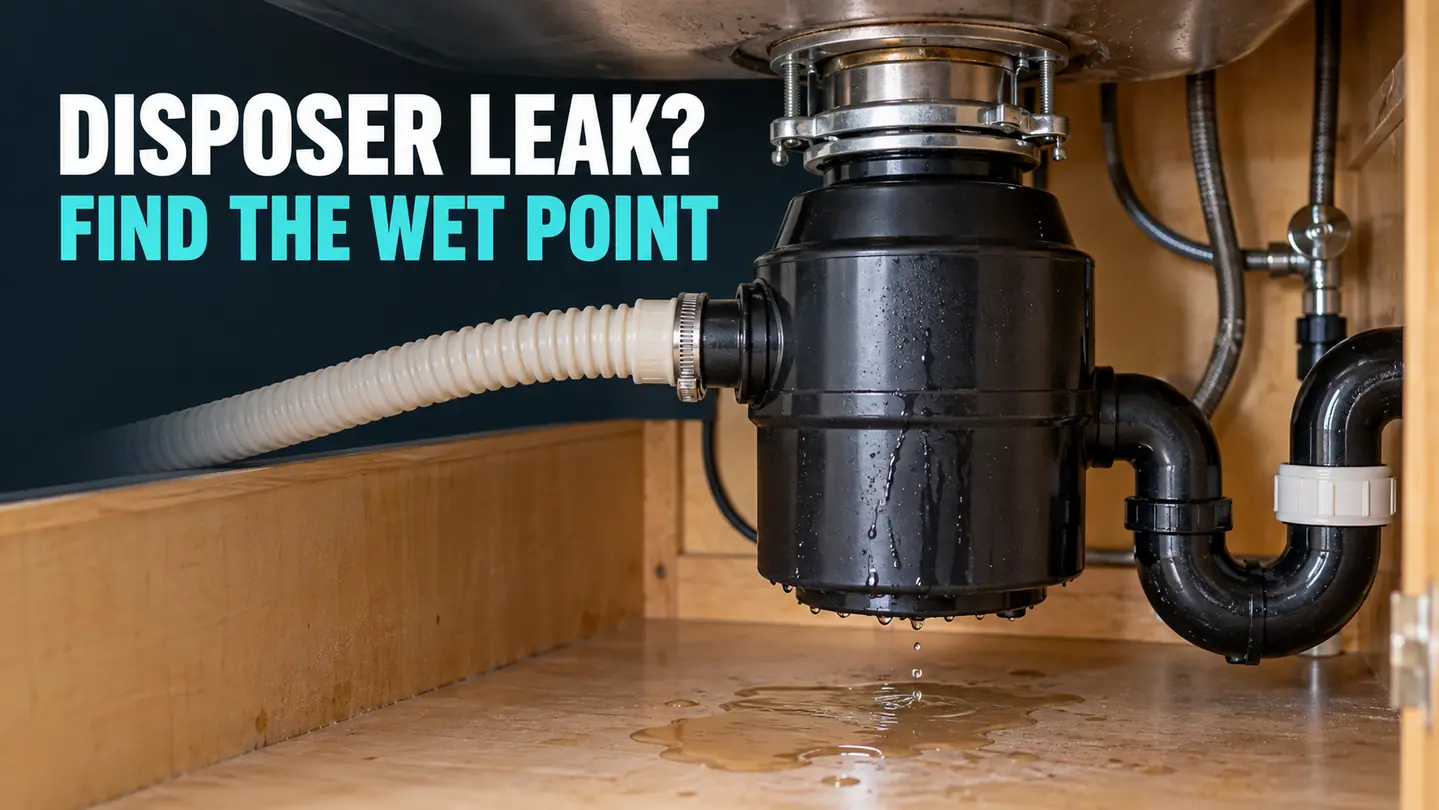
Quick answer: A wet cabinet beneath a U.S. kitchen garbage disposer can point to a leak at its sink mounting assembly, dishwasher inlet connection, discharge pipe joint, or disposer housing—but a drip at the lowest point is not evidence that the motor housing failed. Water often travels along the exterior of the unit from a joint higher up. Locate the first wet point and the electrical hazard before considering any repair.
Exact scope: A standard household garbage disposal mounted under a kitchen sink, with visible mounting ring, optional dishwasher inlet hose, and waste discharge outlet. This is a non-invasive observation and professional handoff guide for U.S. homeowners and renters. It does not cover electrical diagnosis, internal motor repair, jam clearing, or drain disassembly. The examples are hypothetical, not firsthand disposer testing. Official manufacturer sources checked October 30, 2026.
1. The electrical stop rule comes first
- Do not touch a wet disposer body, cord, outlet, switch, or wiring. Do not reach under a wet sink to unplug the disposer or press a reset button. Keep children and pets away and contact a qualified electrician or plumber as appropriate.
- Do not run the disposer—or a dishwasher connected to its inlet—to reproduce a leak. The combination of electricity, water and moving blades is not a safe household test.
- Do not put a hand into the grinding chamber, even when the wall switch appears off. This guide does not ask you to clear a jam or feel for a cracked housing.
- If water is actively spreading, avoid wet electrical areas; use only an obviously identified, safely accessible water shutoff if needed, and seek emergency maintenance if necessary.
- If you rent, photograph the visible condition from a safe dry location and contact the property manager rather than dismantling the unit.
2. Six first-wet-point locations and their limitations
| Where the first fresh droplet appears | Possible connection to investigate professionally | Why this clue is not a final diagnosis |
|---|---|---|
| At sink flange or disposal mounting ring | Sink-to-mount interface or mounting assembly | Water may also be arriving from the sink rim or faucet above |
| At dishwasher inlet hose/port | Hose attachment or disposer dishwasher inlet | A nearby drain hose can carry water from farther away |
| At discharge outlet to drain piping | Discharge connection, gasket or downstream drain joint | A wet outlet may be runoff from a higher mount |
| Along disposer sidewall/body | Housing or joint, or water tracking down exterior | Sidewall wetness alone does not establish a cracked body |
| At bottom of disposer | Water may have traveled down from any upper connection; lower housing leakage is also possible | The bottom is a collection point, not proof of the source |
| At adjacent P-trap or neighboring plumbing | Separate sink drain, trap or supply assembly | Not every under-sink leak is a disposer defect |
InSinkErator’s official Garbage Disposal Leaking support page separates mounting assembly, dishwasher inlet, discharge and body/bottom locations. That classification is useful because a homeowner’s description “the disposal is leaking” hides several different failure paths.
3. Mounting assembly: water above the machine
The mounting ring is located near the underside of the sink bowl. A droplet beginning near the sink flange or mount could indicate an installation or sealing problem, but the first wet point matters: water from a dripping faucet, sink-rim spill, or separate fitting can reach the same area. InSinkErator publishes separate mounting-assembly troubleshooting. Its guidance is manufacturer-specific; do not assume all mounts are identical.
What to document: whether the wetness is on the sink underside above the mounting ring, at the ring itself, or only on the disposer shell below. Do not twist or release a mount while the cabinet is wet.
4. Dishwasher inlet: one connection, two appliances
A dishwasher often drains through a hose connected to the garbage disposer. If water starts at that hose entry, the dishwasher inlet connection is one plausible source. InSinkErator has a separate dishwasher-inlet leak guide. The visible wet point should be reported without assuming whether the hose, clamp, port, dishwasher, or downstream drain is at fault.
Important distinction: a dishwasher inlet connection on the disposer is different from water leaking out of the dishwasher door or its fresh-water supply. For those other symptoms, use the site’s dishwasher door / supply / drain guide. Do not run a dishwasher cycle to recreate a known cabinet leak.
5. Bottom and housing: a common reasoning trap
Because gravity pulls water down, the bottom may be the last surface to get wet. One isolated photograph of a wet base cannot separate a leak at the mounting ring from one at the dishwasher hose or the body joint. If a qualified person determines water originates from the housing, follow manufacturer service guidance for the exact unit. Repair versus replacement depends on the actual leak location, model, condition and service options—not on the puddle’s location alone.
6. Use the no-contact observation sheet
- Take a wide photo of the under-sink plumbing from outside the cabinet; avoid wet electrical components.
- Note the first place that looked wet: mount, hose port, discharge joint, shell, bottom or neighboring pipe.
- Record whether water appeared when the faucet had been used, after a dishwasher cycle already completed, or at an unknown time. Do not intentionally run either appliance to test it.
- Note whether water is near an outlet, cable, plug, or disposer switch. This changes urgency.
- Record any swelling of the cabinet floor or water reaching the room outside the cabinet.
- If safe, place a warning for household members not to operate the unit until the issue is assessed.
7. Three hypothetical observations and what each justifies
| Example | Limited facts | Reasonable next step |
|---|---|---|
| A — water visible at dishwasher inlet | The upper dishwasher hose port is wet; the disposer base is also wet | Report “first noticed at inlet” and seek qualified assessment of hose/port; no cycle test |
| B — drip at mounting assembly | Wetness begins just below the sink flange before traveling down the disposer | Report possible mounting leak; do not release the ring or touch wiring |
| C — wet bottom only | Cabinet floor and disposer underside are wet, but upper origin cannot be seen safely | Treat source as undetermined and electrical exposure as a priority; stop use |
These examples are decision illustrations only; the site did not inspect these kitchens, test products, or establish component failure rates. A professionally verified finding may differ.
8. Frequently asked questions
If only the bottom is wet, do I need a new disposer? Not enough information. The water could have traveled from a fitting higher up. A qualified inspection must locate the source before deciding between a connection repair and unit replacement.
Should I run the dishwasher to find out whether the inlet is leaking? No. If water and a powered disposer share a wet cabinet, intentionally reproducing the leak adds risk. Document past use and request a professional check.
Can I put sealant around the disposer body? Not as a fix for an unidentified leak. A patch could hide the source and is not a substitute for the manufacturer’s service guidance.
Related reading and primary source links
For a separate pull-down faucet spray-hose symptom, read Pull-Down Kitchen Faucet Hose Leak: Safe Clues. Use the Home Leak Triage Worksheet for the evidence log and Articles for symptom-specific guides. Our research scope appears in Our Story.
- InSinkErator, Garbage Disposal Leaking (manufacturer’s location-by-location troubleshooting).
- InSinkErator, Garbage Disposal Leaking at the Dishwasher Inlet.
- InSinkErator, Garbage Disposal Leaking from the Mounting Assembly.
- U.S. EPA WaterSense, Fix a Leak Week (general household leak identification).