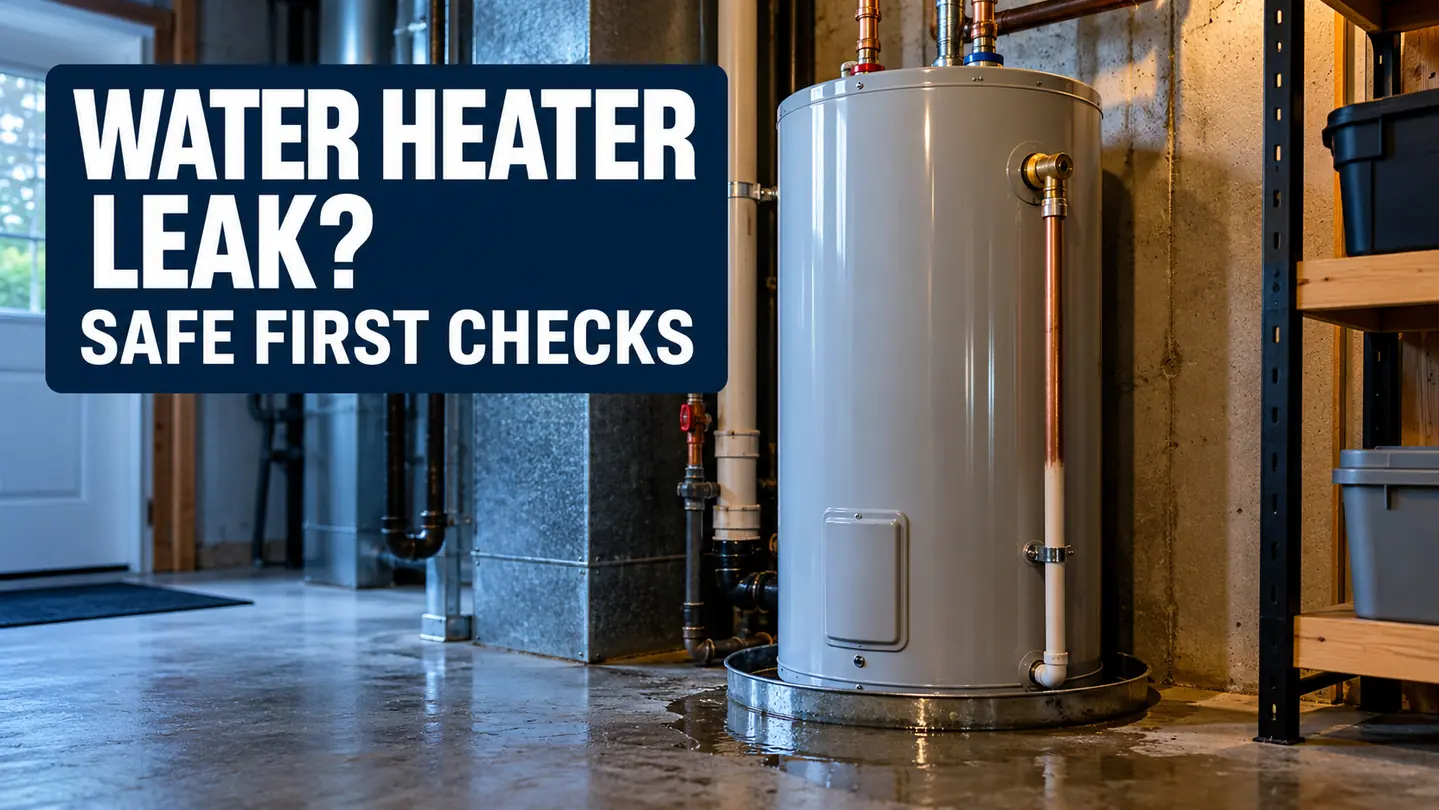
Quick answer: A puddle beside a residential water heater does not identify the failing part. Look only from a safe, dry position for the first visible wet point: a top supply connection, the end of the temperature-and-pressure (T&P) relief discharge pipe, the lower drain-valve area, or water apparently emerging from the tank itself. Do not open panels, operate the T&P lever, cap any discharge pipe, or touch wet electrical equipment. If the water is hot, spreading, or near electricity, move away and arrange urgent qualified help.
Who this guide is for: U.S. homeowners, renters, and property managers with a conventional residential storage-tank water heater who need to describe a suspected leak before calling service. Heat-pump, tankless, and unfamiliar installations may have different components: use the specific model manual and a qualified technician. This is an observation guide, not repair instructions or a claim of firsthand testing. Sources checked October 30, 2026.
1. Make the safety decision before tracing water
- Wet outlet, electric water-heater access panel, breaker area, or power cord: do not touch the equipment, standing water, or nearby switches. Keep people away and contact a qualified professional. Do not operate a breaker while standing in water.
- Smell of gas or suspected gas leak: leave the area. Once outside, contact the gas utility’s emergency number or emergency services; avoid using devices or switches near the suspected gas.
- Scalding water, steam, active spray, or rapidly expanding puddle: do not approach hot discharge or try to catch it with your hands. Arrange urgent professional assistance.
- When no immediate hazard is visible: take photographs from a dry floor. If you know the location and safe operation of the home’s water shutoff, follow your equipment’s instructions; otherwise ask maintenance or a licensed plumber.
Important: the T&P relief valve is a safety device. Never plug its pipe or treat repeated discharge as an ordinary nuisance drip. Manufacturer guidance states that the discharge can involve high water pressure, thermal expansion, or unsafe temperature conditions; the cause requires a qualified assessment. See the A. O. Smith T&P valve technical bulletin.
2. Use the first-wet-point comparison, not the puddle alone
Observe from the outside. The puddle’s lowest point can be several inches or feet away from the source because water follows pipe jackets, insulation, and the floor. The following is a triage table, not a probability estimate or fault diagnosis.
| What you can observe without touching the heater | A possible source—not a diagnosis | Best next step |
|---|---|---|
| Fresh moisture begins at a top pipe or connector and tracks downward. | Cold-water inlet, hot-water outlet, or another supply fitting. | Photograph the highest visible wet point; have a qualified plumber examine the connection. |
| Water appears at the end of the side discharge pipe, perhaps intermittently. | Temperature-and-pressure (T&P) relief valve discharge; pressure or thermal expansion may be involved. | Do not cap or operate the valve. Stop using the affected system if unsafe and request prompt professional evaluation. |
| Moisture is concentrated near the lower drain valve. | A drain-valve connection or water traveling from elsewhere. | Note whether water is visibly originating at the valve; do not twist a stuck or hot fitting. |
| The pan or floor is wet, but all visible fittings look dry. | Could be tank failure, condensation, another nearby line, or water tracking from an unseen point. | Document the location; ask the technician to confirm the actual source before recommending replacement. |
| Water is spreading rapidly, is very hot, or reaches electrical equipment. | Urgent safety and property-damage risk regardless of source. | Keep clear, avoid wet electrical equipment, and contact emergency maintenance or a qualified professional. |
Why this distinction matters: water at the base does not identify the failed component. A. O. Smith Technical Bulletin 52 discusses temperature-and-pressure relief-valve discharge, but that bulletin does not diagnose every tank or fitting. Its technical remedies are for qualified personnel, not instructions to disassemble a heater. Compare only visible clues and obtain a model-specific professional assessment.
3. A five-field water-heater leak record
Write down facts that a plumber, landlord, or warranty representative can check against the equipment. You do not need to trigger heating cycles or run hot water as a test.
- Time: when the moisture was first noticed; when the last photograph was taken.
- Visible location: top pipe, side discharge pipe end, lower valve area, tank jacket, pan only, or source not visible.
- Water pattern: isolated droplet, thin trail, puddle, or spreading flow. Note whether it appears hot only if safely known—never touch or taste it.
- Operating context: whether the heater recently ran or someone used hot water, if already known. Do not start a cycle to manufacture evidence.
- Action and next contact: whether water use was limited, whom you notified, and what the service professional advised.
4. Three worked examples—illustrations, not field tests
Example A: Water trail starts at the top connection
A resident photographs an upper pipe joint visibly wet and a narrow trail down the heater body. This favors a connection-source question over simply labeling the entire tank bad. It does not prove the joint failed: nearby condensation can resemble a small leak. The service question is, “Can you identify the first wet connection and confirm it safely before recommending tank replacement?”
Example B: Discharge pipe has intermittent water
A homeowner sees moisture at the end of the T&P discharge pipe and records that it occurred near an ordinary heating period. This is not a reason to close, plug, or manipulate that pipe. The licensed professional should evaluate the relief device and system conditions, including pressure and thermal expansion. A. O. Smith’s maintenance guidance identifies these as potential causes; one observation alone does not distinguish them.
Example C: Only the pan has standing water
A renter finds water in the drain pan but cannot see a wet fitting from the accessible side. The honest conclusion is “source unconfirmed.” A contractor may need to assess the tank, connections, condensation, or nearby plumbing. Before any replacement quote, the renter provides photos, model details, and the time the water was noticed—without removing the heater cover.
5. The questions that make a service call more useful
- Where is the first confirmed wet point, and how did you verify it?
- Is water coming from a supply connector, relief discharge, drain valve, tank wall, or an unrelated line?
- If the T&P discharge is involved, have pressure/expansion and the valve condition been assessed according to the model manual?
- Is the recommendation to repair a connection, perform further diagnostics, or replace the tank? What evidence supports that choice?
- Can the estimate separate diagnostic work, parts, labor, disposal, and any code-related installation requirements?
For a tenant, report the observations to the property manager and follow the lease’s emergency-maintenance process. Do not attempt repairs to equipment you do not control.
6. What not to infer from a wet floor
- “The bottom is wet, so the tank is broken.” Not established. Moisture may travel down from a fitting or discharge pipe.
- “The puddle dried, so the problem is fixed.” Not established. Some leaks are intermittent or cycle-related.
- “An occasional T&P drip is safe to ignore.” Not established. The relief device is safety-critical and warrants qualified evaluation.
- “I must lift the relief lever to test it.” No. This guide intentionally excludes that hands-on test because hot water and pressure can cause injury.
7. Related U.S. home leak checks
If the source is not around the heater itself, use the safe main shutoff leak guide only when that valve or its connections appear wet. For a suspected hidden continuous supply leak, the no-use water meter check may help only after active hazards are handled. Condensation is one possibility to document, not proof of a cause. If a pipe has ruptured or water is spreading rapidly, stop testing and seek qualified emergency help.
Frequently asked questions
Does every puddle under a water heater mean replacement?
No. Manufacturer troubleshooting materials describe several possible sources. Only a qualified inspection can establish whether the storage tank has failed.
Can I plug a dripping relief pipe until service arrives?
No. A T&P relief outlet must remain unobstructed. Stay away from hot discharge and arrange professional evaluation.
Should I try to tighten a wet hot-water fitting?
This guide does not recommend it. Hot water, pressure, electricity, and gas may all be present; document the wet point and contact a professional.
Official sources and editorial method
- A. O. Smith — Technical Bulletin 52: Leaking Temperature and Pressure Relief Valve (manufacturer source).
- A. O. Smith — Water Heater Maintenance Guide (discharge and pressure context).
- U.S. EPA WaterSense — Fix a Leak Week (general water leak awareness and meter observations).
- Our editorial method (how we label sources, limitations, and illustrative examples).
Editorial disclosure: The comparison table and three scenarios are original explanatory frameworks assembled from cited manufacturer guidance; they are not results of a physical inspection, controlled experiment, or independent product testing. Plumbing systems vary. For immediate danger, put safety before troubleshooting.
Source applicability correction reviewed November 14, 2026: A previously cited PDF (document 100293647) was a commercial electric water-heater manual, not a general residential “leakage checkpoints” diagram. That citation was removed. Exact model instructions and qualified inspection govern any repair.