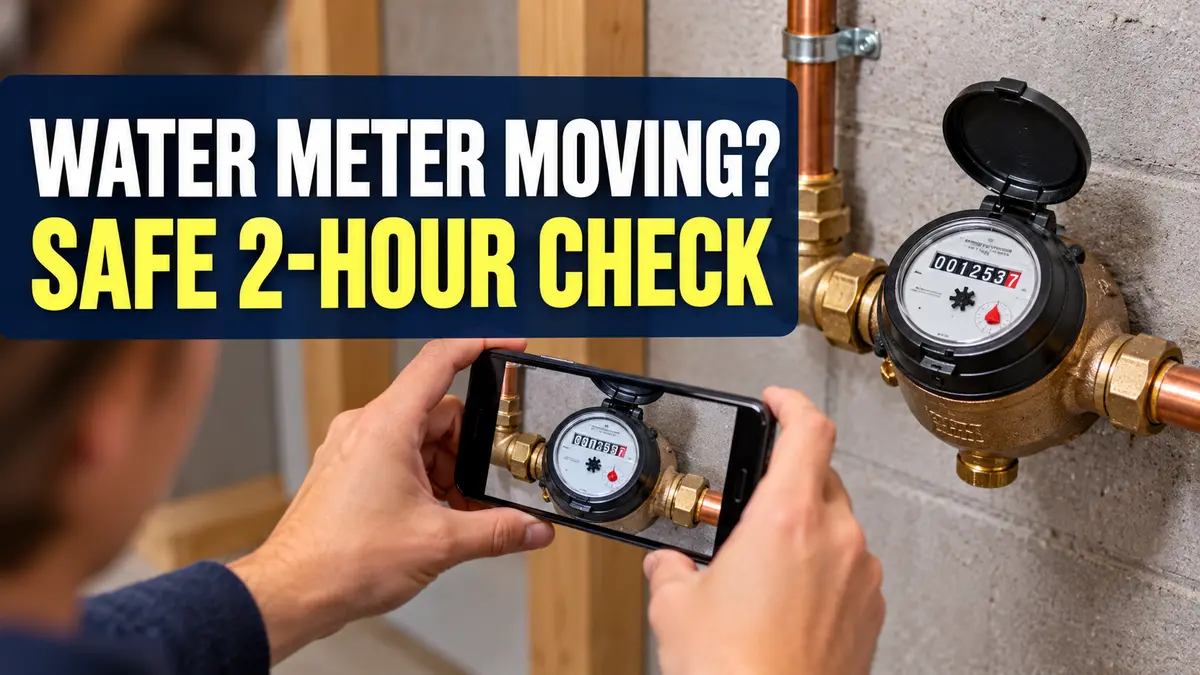
Updated October 30, 2026 · First published October 7, 2026. If your water meter changes during a period when nobody uses water, water passed through the meter during that interval. That is a useful clue—not proof of a leak, and not a way to identify the source. This guide explains how to make a safe two-hour comparison, read the units correctly, account for automatic equipment, and decide what to ask your water utility or a licensed plumber.
Stop first: Do not enter standing water, reach into a street-side meter box, lift a heavy or stuck cover, touch wet electrical equipment, or delay help for an active major leak. If the meter is unsafe or inaccessible, ask your utility how to read it. A water check must never put you in danger or interrupt an essential household need.
What the two-hour meter check can show
The U.S. Environmental Protection Agency (EPA) recommends reading a home’s water meter when no water is being used and reading it again two hours later. A changed reading can indicate unexpected water use and is a reason to investigate. The meter reports flow through the meter; it does not tell you which fixture, appliance, irrigation line, or pipe used the water.
A result that does not change is also limited. A small flow may be below the display’s readable increment, a leak may happen only at certain times, or an automatic device may not have run during the test. EPA’s educational worksheet cautions that a meter registering cubic feet may not show a small leak in a two-hour window. Treat the result as one observation, not an all-clear.
Before you start: make the comparison meaningful
- Confirm that you can reach the meter safely. Residential meters may be indoors or in a box near the curb, but locations and access rules vary. Do not stand in traffic, enter a flooded vault, force a lid, or tamper with utility equipment. Call the water provider for safe access instructions.
- Identify the unit and the digits you will compare. A meter may display gallons, cubic feet, CCF (100 cubic feet), or another utility-specific format. Photograph the full display and its labels. Follow the meter or utility instructions; do not mix the main register with a small sweep dial or assume every colored digit has the same meaning.
- Let normal cycles finish first. Wait for a toilet to finish refilling and avoid starting laundry, dishwashing, irrigation, or other water use. Ice makers, water softeners, reverse-osmosis systems, humidifiers, and other equipment may use water automatically. Do not disable safety-critical or essential equipment; postpone the check or record that an automatic cycle could affect it.
- Choose a time when household water can reasonably remain unused. Do not skip drinking, handwashing, medication-related care, or another necessary use just to complete a test. If water is used, note it and restart at a more suitable time if safe.
How to do the no-use check
- From a safe position, photograph the complete meter display. Write down the date, start time, unit, and every clearly readable register digit.
- For the next two hours, do not deliberately run water at the home’s fixtures or appliances. Do not shut, turn, or force a valve for this screening check. If someone needs water, use it and record that the interval was interrupted.
- After two hours, photograph the same display and record the end time. Compare the same register and units, including decimal places only where the meter clearly identifies them.
- If the reading changed, write down the difference and any known automatic use. If it did not change, record “no change visible at this meter’s displayed resolution during this interval”—not “there is no leak.”
- If the outcome is unclear, do not keep repeating tests back-to-back. Ask the water utility how its meter should be read and whether its customer portal or leak-alert service can provide a useful comparison.
Example: read the unit before interpreting the number
Hypothetical calculation—not a household measurement: Suppose a meter clearly records CCF and the displayed reading increases by 0.03 CCF in a valid no-use interval. One CCF is 100 cubic feet, and EPA’s conversion material uses about 7.48 U.S. gallons per cubic foot. The displayed difference is therefore approximately 22.4 gallons (0.03 × 100 × 7.48). This calculation describes the meter difference only. It does not establish whether the water came from a leak, an overlooked use, or an automatic cycle, and meter precision and display conventions vary by model.
| Observation | What it supports | What it does not prove |
|---|---|---|
| Same register is higher after a valid no-use interval | Water passed through the meter during that interval | The location, failed part, repair cost, or responsible party |
| No visible change after two hours | No change was readable at that meter during that period | That all small, hidden, or intermittent leaks are absent |
| Reading changes while an automatic device may have run | The result is affected by unobserved or scheduled water use | That the device is defective |
| Higher bill but no meter change in this check | Billing days, rates, seasonal use, display resolution, or intermittent use still need review | That the bill is wrong or that the home is leak-free |
If the reading changes, narrow the next question safely
First confirm the times, units, and whether anyone used water. Consider whether an ice maker, softener regeneration, irrigation timer, or other automatic system could have run. If you can do so from a dry, safe location, look for visible water around accessible fixtures and appliances; do not move a connected refrigerator or washer, open walls, remove equipment covers, or touch a wet electrical area.
Ask the utility to explain what the meter serves and where its service responsibility ends. The meter may include outdoor or shared uses, and utility/customer responsibility for the service line varies by location. If unexpected flow remains unexplained, a licensed plumber can help isolate home plumbing. Renters should document the reading and promptly notify the landlord or building manager as their lease requires.
If the reading does not change
Keep the result as a time-stamped observation. It does not rule out a leak that occurs during a washer fill, softener regeneration, irrigation schedule, or another intermittent event. A slow flow can also be hard to see on some meter displays. Compare the meter’s unit and smallest readable increment with the utility’s instructions, and ask the provider whether a longer interval or its own usage data would be more informative. Do not extend a test if that would interfere with household needs or safety.
A bill comparison is a separate question: check the billed volume, billing-day count, and current utility rates against a comparable period. A higher dollar amount alone does not identify a leak. For a toilet-specific check, see our separate EPA-based toilet dye-test guide.
Simple record to share with the utility or plumber
| Record | Your note |
|---|---|
| Meter location and whether it was safe to access | ____________________________ |
| Displayed unit and register read | ____________________________ |
| Start date/time and photo saved | ____________________________ |
| End date/time and photo saved | ____________________________ |
| Known household or automatic water use | ____________________________ |
| What remains unknown or unsafe to check | ____________________________ |
| Utility, property manager, or professional contacted | ____________________________ |
Leave any field blank if you cannot observe it safely. A useful record separates what you saw from what you suspect; it does not need to name a failed part.
Quick checklist
- Access the meter only if the location and cover are safe.
- Record the unit and the same visible digits before and after.
- Wait until normal refills and known automatic cycles have finished.
- Keep water use paused only when household needs allow; note any interruption.
- Interpret a change as flow during the interval, not as a diagnosis.
- Interpret no visible change as limited to that display and time window.
- Ask the utility or a licensed plumber when the source or service boundary is unclear.
Sources and editorial limits
- U.S. EPA WaterSense: Home Maintenance — meter comparison during a no-use period, utility leak alerts, and related home leak checks.
- U.S. EPA WaterSense Student Worksheet — meter units and the limitation that small flows may not appear during a short interval on a cubic-foot meter.
- U.S. EPA WaterSense: Leak Detection and Flow Monitoring Devices — overview of monitoring systems and selection considerations.
Editorial note: We reviewed the linked EPA materials for this guide on October 30, 2026. The unit example above is an explicitly hypothetical calculation. NOVALYRAHUB did not take a household meter reading or perform a plumbing inspection for this article. This guide is general education, not a diagnosis or repair instruction. For immediate hazards or uncontrolled water, keep clear and contact appropriate professional or emergency help. Continue with our safe home-leak observation worksheet or symptom-based guide index.
Before you contact the utility: a meter-evidence handoff
Record whether the display is dedicated to your dwelling or appears to be shared; in a multi-unit building, confirm the meter-to-unit mapping with management rather than assuming every change reflects your own fixtures.
Send the start and end photographs with the time stamps, identical units, any water use that interrupted the interval, and a note of automatic equipment that may have cycled. Ask the utility to explain the register precision before drawing a conclusion.
Independent evidence stress test: when a meter change is not a leak diagnosis
Why this analysis is different: a meter reading is an observation; a leak diagnosis needs a valid control period and a known meter-to-home relationship. The following cases are hypothetical editorial checks, not measurements made in a household.
| Two-hour observation | What is supported | What is still unknown / next action |
|---|---|---|
| Register 218.36 → 218.39, same displayed units, no known water use | Change of 0.03 register units during the interval | Do not label this 0.03 gallons or a specific leak. Confirm units, automatic appliances and whether the register serves only this home; share dated photos with the utility. |
| Same change, but an irrigation timer or ice maker ran | Water use occurred or may have occurred | The no-use assumption failed. Do not attribute the difference to hidden plumbing leakage. |
| Register unchanged during a valid check | No change was visible at that display precision in that interval | This cannot rule out intermittent leaks or a leak below display resolution. |
| Meter may serve several units | Only a reading from the displayed register | Confirm the service mapping with building management or the utility; do not diagnose a neighbor’s or shared pipe. |
Reusable evidence packet: photo/time A → photo/time B → visible units → planned no-use period → any appliance exceptions → meter ownership/mapping → safest next contact. EPA WaterSense explains the original meter comparison; the uncertainty tests and conditional conclusions here are this guide’s independent analysis. No meter was operated or inspected for this article.
Method update: November 13, 2026. This is a document-based editorial comparison and explicitly labeled hypothetical exercise. It is not a claim of first-hand inspection, purchase, travel, repair or real-user testing.
Leave a Reply