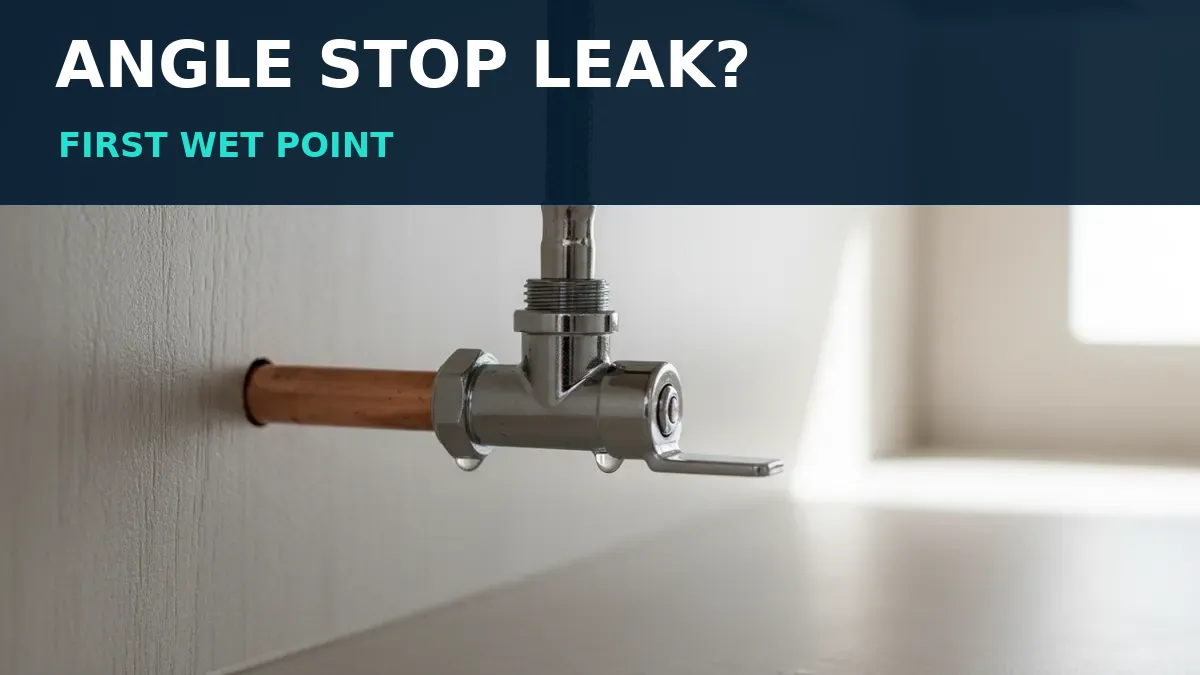
Quick answer: Water beneath a U.S. kitchen sink does not establish that the faucet, drain, or wall pipe has failed. If the cabinet is safe to approach, note the first visible wet point and whether it appears while the faucet is not being used or only after normal faucet use. An angle-stop valve (the small fixture shutoff at the wall or floor) can be wet at its handle/stem, valve body, outlet coupling, or upstream pipe. Those locations call for different information in a plumber’s service request. Do not tighten a pressurized fitting, force a stuck valve, or run water to reproduce an active leak.
Scope: Homeowners and renters in the United States who can visually inspect an accessible kitchen sink cabinet from a dry, safe position. This is a non-invasive observation and reporting guide, not instructions to repair or certify a valve. Manufacturer, landlord, local code, and emergency instructions take priority. Sources reviewed: November 1, 2026.
1. First decide whether observation is safe
- If water is near a disposal electrical outlet, plug, receptacle, or any wet wiring, stop and stay clear; do not touch wet electrical equipment. Do not enter standing water to operate a breaker. Seek qualified electrical help.
- If spraying or uncontrolled water is spreading, keep people away and use an already-known, accessible and safe shutoff only if it can be operated without entering water or forcing damaged equipment. Otherwise request urgent qualified help.
- Do not crawl deep into a cabinet, move connected equipment, pull on braided lines, loosen fittings, test a seized handle, or use paper towels against live electrical parts.
- For a rental or shared building, report the issue to the responsible property manager promptly; local responsibilities differ.
The CDC’s electrical-hazard guidance supports staying clear of wet electrical equipment and not operating electrical equipment while standing in water. Our cautious stop conditions for plumbing fittings are an editorial safety boundary, not a manufacturer’s repair procedure.
2. Identify the exact part—not merely the puddle
An angle stop is a small valve usually located where a household supply pipe enters a sink cabinet. Its job is to control water going to the fixture; it is not the house-wide main shutoff. The BrassCraft angle-stop product page describes this fixture-specific function, but dimensions and handling depend on the exact model. A wet spot at the cabinet floor could also have traveled down from a faucet hose or sink drain. Observe, do not assume.
| First visible moisture | Competing source | What the clue cannot prove | Safe next communication |
|---|---|---|---|
| Valve handle or stem area | Valve stem/packing or water arriving from above | That a particular packing part failed | Photo of handle area, valve position if already known, whether actively dripping |
| Outlet connection where braided line meets valve | Supply connector or outlet fitting; runoff from higher tubing | That tightening the nut would fix it | Photo showing entire connector route and first visible wet point |
| Valve inlet / pipe at wall or floor | Wall supply connection or water traveling along pipe | That the hidden pipe is sound or broken | Report wall-entry moisture; request qualified plumbing assessment |
| Faucet hose high above the valve | Faucet-side hose, mixing assembly or spray line | That the angle stop itself leaks | Trace only visible wetness without touching line; use faucet-specific guide |
| P-trap or drain tailpiece | Drain-side leak during prior sink use | That a pressurized supply valve failed | Report drain-side location; consult drain guide |
The Moen under-sink leak guidance distinguishes home shutoff valves and household supply lines from faucet supply lines, and separates continuous wetness from moisture after faucet operation. That guidance concerns Moen configurations and does not identify the part installed in another home. The decision table above is our adaptation for a homeowner’s documentation, not a universal diagnostic rule.
3. The two-axis evidence grid: timing × first wet point
This page’s reusable tool records two independent dimensions. Axis A: time—noticed when nobody was using the fixture, during ordinary use, after it, or unknown. Axis B: location—the highest visible wet point you can safely see, not the largest puddle. If the cabinet is already wet, never run a faucet cycle just to fill an empty grid cell.
| Timing you already observed | First wet point: valve or wall | First wet point: faucet hose | First wet point: drain | If unknown |
|---|---|---|---|---|
| At rest / no faucet use observed | Supply-side concern possible; report whether drip continues | Supply line or residual runoff possible | Prior stored moisture cannot be ruled out | Record ‘at rest observed; source unknown’ |
| During ordinary use | Could be upstream runoff or supply fitting—do not infer cause | Faucet-side pattern worth manufacturer/model review | Drain timing may be relevant | Record use type without repeating it |
| After ordinary use | Note whether water is still arriving or merely pooled | Drip migration may obscure origin | Drain-side residue plausible | Record first discovery time only |
| No reliable time record | Do not label leak ‘continuous’ | Do not label it ‘faucet-only’ | Do not label it ‘drain-only’ | Take one safe photo; ask pro to assess |
Why this tool is useful: Timing and location are different pieces of evidence. A wet angle stop below a dripping faucet supply hose can mislead a homeowner into requesting the wrong valve replacement. Conversely, moisture first seen around the wall entry should not be dismissed as a faucet splash. The grid produces a clear report while preserving uncertainty.
4. Two labeled hypothetical cases
Hypothetical case A — likely faucet-side investigation: A homeowner discovers water in a kitchen cabinet just after ordinary dishwashing. A photo taken without moving any tubing shows moisture on a higher flexible faucet hose and droplets farther down the valve. The grid yields time: after use; first visible point: faucet hose. The homeowner stops use, reports the higher hose clue, and refers to model-specific faucet information. The grid does not confirm a failed hose.
Hypothetical case B — urgent wall-entry assessment: A renter notices moisture immediately beside the cold-water pipe as it enters the cabinet wall while no one has used the sink recently. The valve handle is dry, but the wall material is damp. The grid yields time: at rest; first visible point: wall-entry pipe. The renter notifies the manager and plumber; they do not twist the small valve to ‘test’ it or open the wall. Alternative sources—including water traveling from elsewhere—remain possible.
These examples are invented teaching scenarios. Neither represents a home visit, test result, customer report, or confirmed plumbing failure. The EPA and manufacturer sources do not validate these two example outcomes.
5. A five-field service handoff card
- Safe location: kitchen or utility sink; exact cabinet side; photo angle.
- First visible wet point: handle / outlet coupling / valve inlet / higher faucet hose / drain / unknown.
- Timing: at rest / during ordinary use / after ordinary use / unknown; first observed date and time.
- Risk: active spraying, wet electrical equipment, damaged wall material, mold-like appearance, or none observed (not ‘none exists’).
- Actions already taken: stopped use, reported to landlord, used an already-safe shutoff, or no action due to danger. Never invent a test.
Copyable report: ‘Kitchen sink, [left/right] cabinet; first wet point [location/unknown]; found [time], relation to normal use [at rest/during/after/unknown]; current risk [description]; safe actions taken [description]; photos available [yes/no]. Please assess the valve, connection, upstream hose and drain as appropriate.’
6. What the primary sources actually establish
- U.S. EPA WaterSense — Home Maintenance: recommends looking under sinks for leaks at pipe connections, puddles, and water spots. It does not establish the failed component from a photograph.
- Moen — Kitchen Faucet: Leaking Under the Sink Base: separates home valves/house supply lines from Moen faucet lines and distinguishes continuous versus post-use clues; model applicability matters.
- BrassCraft — Angle Stop Product Reference: identifies the purpose and model-specific design of an indoor fixture shutoff; it is not a repair instruction for every valve.
- CDC — Electrical Hazards: supplies the wet-electricity stop boundary. The location/timing classification and handoff template are independent editorial tools.
7. Which related guide should you use next?
- If water first appeared higher at the faucet assembly, read the pull-down kitchen faucet hose guide or the bathroom faucet first-wet-point comparison for a comparable fixture pattern.
- If moisture clusters at the trap or drain, see the pop-up drain and P-trap guide for drain-side observations.
- If the house-wide valve is wet instead, use main shutoff valve safety clues; do not confuse it with the fixture angle stop.
- Use the Home Leak Triage Worksheet to preserve your notes for a qualified professional.
FAQ: common mistakes that change the next action
Does a wet angle stop prove the valve is defective? No. A higher faucet hose or drain can wet the exterior of a valve. Record the highest first wet point visible without touching the equipment.
Should I tighten a nut or turn the valve to see whether it stops? Not as a diagnostic experiment on a wet or damaged fitting. Model-specific procedures and conditions differ; forcing a stuck or pressurized component can worsen leakage. Use an already-known safe shutoff only if safe and seek a qualified professional.
What if I cannot see the first wet point? Write ‘unknown’ and preserve one safe photograph. Do not dismantle the cabinet or repeat water use for certainty.
Does a dry photo rule out concealed moisture? No. It records only what was visible at that moment. A professional may need to investigate other paths.
Your safe next step
Stop ordinary water use if it is safe; keep clear of electrical hazards and uncontrolled spraying. Capture only safe, visible evidence. Fill the timing × first-wet-point grid and five-field handoff card with facts, not guesses. Contact the property manager, qualified plumber or appropriate emergency professional based on the risk. No DIY repair is required to use this guide.
Editorial disclosure and limits: Source check performed November 1, 2026 for a U.S. residential context. The grid, cases, and handoff template were written for reader decision support using cited public sources; we did not visit a home, measure a leak, test a valve, or claim plumbing credentials. Local code, lease obligations, equipment design, and urgency vary. This is educational guidance, not a remote diagnosis.