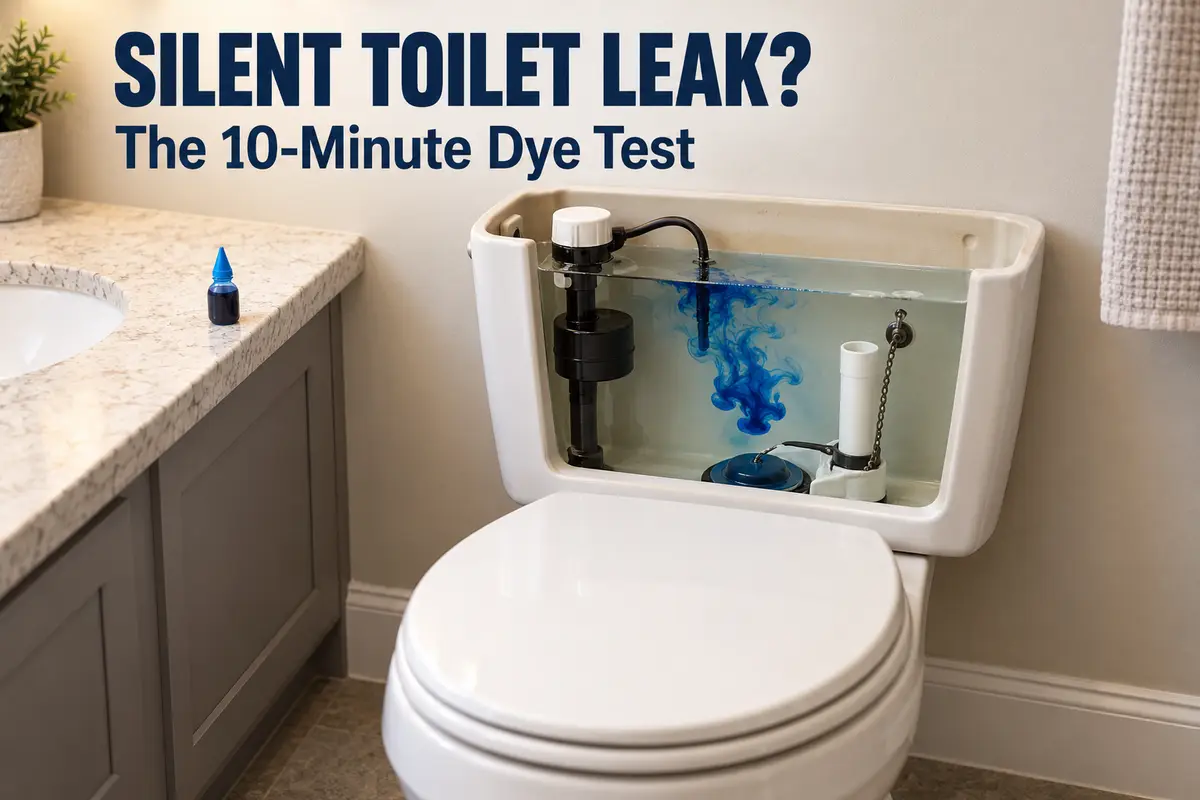
Quick answer: A toilet can lose water silently from its tank into the bowl without leaving a puddle. For a conventional tank-type toilet, an EPA-recommended first check is to add a few drops of ordinary food coloring or a dye tablet to the tank, wait about 10 minutes without flushing, and look for color in the bowl. Color appearing before a flush suggests a tank-to-bowl leak. Flush immediately after the check to reduce staining. A negative result is not proof that all toilet or household leaks are absent.
What the dye test actually checks
In a gravity-fed, tank-type toilet, the tank stores clean water between flushes. The flush valve seal—often a rubber flapper, but sometimes a canister-style seal—should keep that tank water from entering the bowl until a flush. The dye test makes otherwise invisible migration easier to observe. It does not test the seal between the toilet base and floor, the wall supply connector, the wax ring, or every intermittent fault. It may not apply to tankless or flushometer-type fixtures.
Safety and suitability: check before lifting the lid
- Do not begin if sewage is backing up, water is spreading at the toilet base, the tank is cracked, or the fixture is unstable. Stop using it and contact a plumber or property manager.
- Use the test only on a conventional tank-style toilet where you can safely reach and lift the tank lid. Porcelain lids can be heavy and fragile; place the lid on a stable protected surface.
- Do not mix food coloring with in-tank chemical cleaners, chlorine tablets, or other cleaning products. If the tank contains a chemical cleaner, skip the test and follow the product and toilet manufacturer’s instructions.
- Keep dye away from children, pets, porous tile or grout. Wipe spills promptly and follow the EPA advice to flush after the observation period.
- For rented or shared-building fixtures, document the problem and follow maintenance rules; do not disassemble the flush mechanism.
The EPA 10-minute dye test: a repeatable 5-step checklist
- 1. Establish a baseline. Make sure the toilet has not been flushed recently and the tank has finished refilling. Note any occasional refilling sounds. Record the approximate time and whether the area around the base is dry.
- 2. Observe without altering parts. Lift the tank lid if safe. Look for continuous water entering the overflow tube or a visibly displaced seal, without reaching into moving parts. A stream into the overflow tube points toward a fill-level or fill-valve concern, which the dye test alone may not distinguish.
- 3. Add a small amount of dye. Put a few drops of ordinary food coloring or an EPA-style dye tablet into the tank water—not into the bowl. Do not flush or operate the handle during the observation period.
- 4. Wait about 10 minutes. Watch the bowl water from above. If the color appears there before flushing, record the result and photograph it if helpful. A 5–10 minute window is used in EPA WaterSense inspection guidance.
- 5. Flush and document. Flush promptly to remove the dye and avoid staining. Note the result as positive, negative, or inconclusive, along with the approximate time and any spontaneous refills.
The exact procedure is supported by the U.S. EPA WaterSense home-maintenance guidance and the EPA WaterSense technical reference manual. Do not wait longer in hopes of creating a clearer result if the dye might stain the fixture.
Interpret the result without guessing the repair
| Observation | What it reasonably suggests | Safer next step |
|---|---|---|
| Colored bowl water without flushing | Tank water likely crossed the flush valve seal. A worn flapper or canister seal is a common possibility. | Record the result; consult the toilet’s exact model manual or request plumber/maintenance inspection. |
| Bowl stays clear during the test | No tank-to-bowl migration was observed during this short interval. | Do not declare the toilet leak-free. Repeat only if needed after a new symptom; check other fixtures or the water meter for unexplained use. |
| Tank continuously spills into overflow tube | Fill valve or water-level adjustment may be implicated. | Stop unnecessary use and refer to manufacturer guidance. Do not bend or force components. |
| Water is wet at floor or behind toilet | Supply connection, tank fasteners, base seal, condensation, or another source may be involved. | Avoid the dye test as a diagnosis; isolate only a known safe valve and arrange assessment. |
| Dye was added but toilet flushed unexpectedly | Test was interrupted or the toilet may be cycling independently. | Mark the test inconclusive; record the spontaneous flush/refill and seek model-specific help. |
Two worked examples—illustrative, not firsthand tests
Scenario A: the toilet quietly refills every hour. A homeowner notices a short refill with no flush and performs the test with the tank fully refilled. Blue appears in the bowl after eight minutes. The sensible conclusion is a suspected tank-to-bowl leak; the observed color does not prove which seal has failed. The next step is to identify whether this exact toilet uses a flapper or a canister assembly and seek model-correct advice.
Scenario B: the bill rises but the bowl stays clear. A renter observes no color during the 10-minute window. This does not clear the entire home. The next step is to record the negative result, check for visible fixture moisture and ask property management or the water utility about a safe, no-water-use meter comparison. A leaking supply pipe or intermittent valve defect may not show on the dye test.
Published measured example: what a real toilet-repair result does and does not prove
The Portland Water Bureau described a multifamily building where repairs to malfunctioning toilets cut water use by about 12,500 gallons per day. This is a publicly reported utility case from 2021, not a toilet our editors inspected or tested. The city’s figures are property-wide and cannot identify the rate of a specific fixture. Original Portland Water Bureau case report.
| Evidence level | Reasonable conclusion | Wrong leap to avoid |
|---|---|---|
| Municipal utility reported reduced whole-property usage after toilet repairs | Toilet repair can materially affect total measured use in a building. | Assuming the city’s before-and-after number is a per-toilet leak measurement. |
| Dye seen in a toilet bowl without flushing during an appropriate home test | Water is passing from the tank into the bowl in that test condition. | Diagnosing a particular flapper, canister seal, floor gasket or pipe without model-specific inspection. |
| No dye enters the bowl in one observation period | That particular test did not show tank-to-bowl flow at that time. | Concluding the home has no intermittent leak or no other fixture leak. |
Service-call sentence: ‘I used the EPA-style dye check only where suitable; the bowl result was [observed/no color seen/not tested], the test interval was [ ], and the toilet model is [known/unknown]. I have not confirmed which part failed.’ This connects a documented public case to a reproducible personal observation without pretending our team performed a field inspection.
Flapper, canister seal, or fill valve? Why the model matters
Not every U.S. toilet uses a universal flapper. Some models use canister or proprietary flush-valve assemblies, so a random replacement may fit poorly and fail to stop a leak. The KOHLER running-toilet guide discusses seals, floats, chains and fill valves; American Standard’s Champion model guidance illustrates why parts depend on the exact tank design. Locate the manufacturer and tank model number before buying a part; use trained service for work beyond safe observation.
What an informed homeowner should tell a plumber
- Type of toilet (tank-style, one-piece, two-piece, or another visible design) and brand/model if accessible.
- Was the water in the bowl colored before anyone flushed? Approximately how many minutes after adding dye?
- Was water visibly entering the overflow tube or was the fill valve cycling without use?
- Any moisture outside the tank: supply valve, connector, floor or ceiling below?
- When the symptom started, whether the home is rented, and whether a water meter or bill also showed unexpected use.
Stop points and common mistakes
- Never treat dye in the bowl as proof that the floor seal or supply line is faulty—it tests a different route.
- Never assume the absence of dye proves there is no leak. Short tests can miss intermittent problems.
- Never pour concentrated bleach or household cleaning chemicals into the tank to simulate a dye test.
- Do not tighten porcelain tank bolts by force or detach the toilet from the floor as part of this check.
- If the tank is damaged, the toilet is unstable, water is on the floor, or wastewater is present, prioritize safety and qualified repair.
Independent EPA desk check: two tests, two different questions
Checked October 30, 2026: EPA WaterSense describes a roughly 10-minute tank dye check and a separate two-hour no-use meter observation. The following distinction is our editorial analysis of those two methods, not a report that we physically tested a toilet.
If dye appears in the bowl without flushing, that supports investigating tank-to-bowl flow; it does not identify which replaceable seal is faulty. If no dye is seen but the meter registers water when no fixtures are used, do not dismiss a possible leak elsewhere. A toilet dye test does not screen every household leak route.
This source-to-interpretation comparison and a record of what the official pages do not establish are documented in our October 30 source-verification desk log.
| Result pattern | Next evidence-based question | Invalid shortcut |
|---|---|---|
| Dye reaches bowl without a flush | What toilet model and tank components does its manual show? | The floor seal, supply hose or particular part is proven faulty |
| No visible bowl dye, meter moves during true no-use period | Could water be used or lost in another branch or fixture? | The house has no leak because toilet dye stayed in the tank |
References, method, and editorial limits
This is a source-based U.S. homeowner decision guide, not a documented on-site inspection, licensed diagnosis, or a claim that an author personally performed the example tests. The worked scenarios are hypothetical illustrations. Core procedural source: EPA WaterSense Home Maintenance; inspection protocol: WaterSense Labeled Homes Technical Reference; broader household guidance: EPA Fix a Leak Week. Manufacturer-specific references: KOHLER and American Standard. Always follow product instructions and local rules; repair ownership and plumbing codes differ by jurisdiction.
Related guide: If you are checking a higher-than-usual household water bill as well as a toilet, read our home meter and leak-check guide for a broader household screening approach.
Leave a Reply