Quick answer
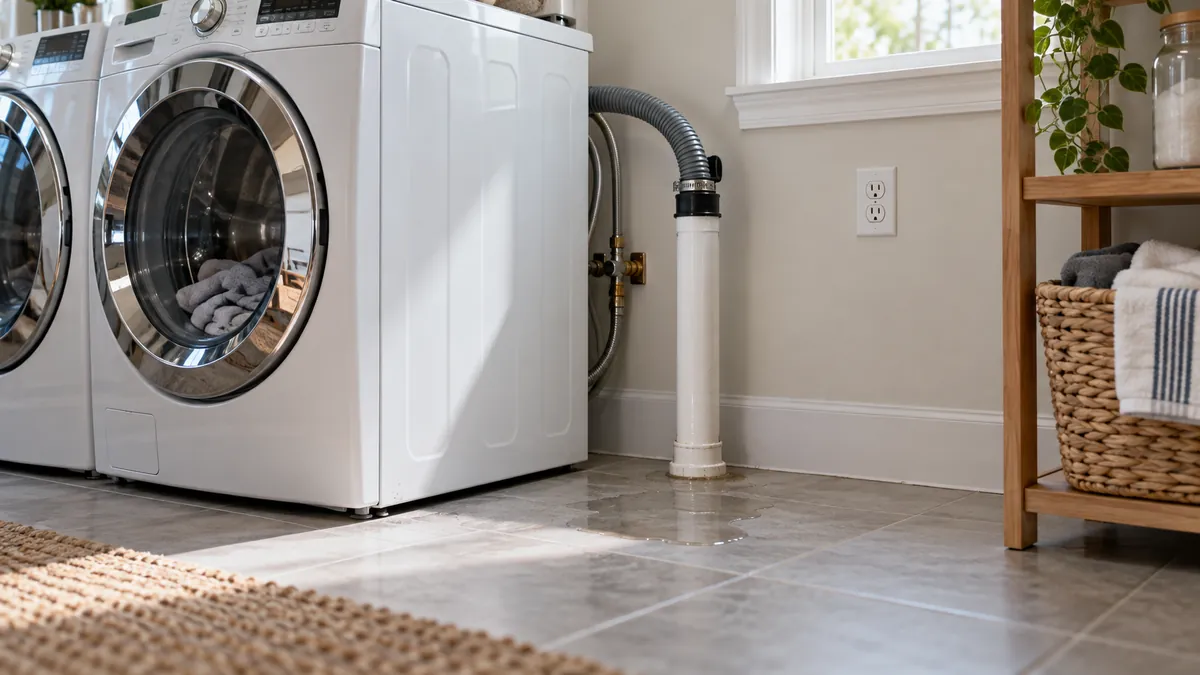
Water behind a washing machine during a drain cycle can come from an overflowing standpipe, an escaping drain hose, or a supply connection. The time it appears matters, but water can travel beneath the machine and disguise the starting point. If water is escaping, stop operation using a dry accessible control only and arrange service. Do not pull a heavy, wet machine away from the wall or reach across a wet outlet.
What a standpipe does
A standpipe receives discharged washer water into the building drain. A backup at its opening can indicate a drain restriction, poor hose placement, or a capacity mismatch. A hose also may move or separate. Distinguishing these requires observing the accessible path, not forcing water through a suspect drain with repeated laundry cycles.
Compare four symptom patterns
| When water appears | First wet point | Priority |
|---|---|---|
| During machine filling | Supply valves or inlet-hose connection | Stop water supply if safe; plumber or appliance service |
| Only during pump-out | Standpipe rim or drain hose | Stop cycle; drain/plumber assessment |
| Beneath machine at multiple stages | Appliance internal source possible | Appliance technician |
| Even while washer idle | Other supply pipe or fixture possible | Check known external sources; plumber |
Safe sequence
- Stop the cycle if leaking; do not repeat a full wash as a test.
- Photograph the floor and any visible standpipe opening from a dry safe location.
- Record whether the symptom happened on fill, agitate, drain, or idle.
- Avoid pulling out a plugged-in heavy machine; never touch wet electrical connections.
- Send the model, observed timing, photos, and any drain smell or backup history to a plumber or appliance technician.
Observation-based decision check: does the visible water path fit the pump-out timing?
A drain-phase puddle is a clue, not proof that the standpipe is blocked. This decision ledger separates directly observed water, competing explanations, and the safest service request. Use an earlier photo or an observation made during normal use; do not restart a leaking washer to fill the table.
| Evidence actually available | A competing explanation | Decision that evidence supports |
|---|---|---|
| Water was visibly rising over the standpipe lip while the pump ran | Drain restriction, hose positioning or discharge volume may differ by installation | Stop washer use; tell a plumber the standpipe overflow was directly seen. Do not seal the opening. |
| Water on the floor only; standpipe opening was not visible | Supply connection, drain hose, appliance interior, or water traveling from a neighbor fixture | Source remains unverified; send wide and close photos, model, cycle phase, and ask whether plumbing or appliance service should inspect first. |
| The standpipe rim looked dry but water began below the washer | An internal hose, pump, or another hidden path is possible | Do not pull the heavy plugged-in appliance; arrange appliance service and report that the drain opening was not seen overflowing. |
| A sink or floor drain nearby also backed up | Shared drainage trouble may contribute; washer hose failure is not excluded | Mention the other fixture to a plumbing professional and stop using affected drains. |
Hypothetical record, not our field measurement: 07:12 — pump-out noise noted; 07:13 — water seen only on the floor; standpipe mouth hidden; 07:14 — cycle stopped from a dry control. The honest conclusion is “source unknown during drain phase,” not “definite clog.” The value of the log is the clear limit it communicates to a technician. See our evidence-labeling method.
A useful counterexample
Hypothetical comparison, not a performed test: Two homes have puddles behind washers. In one, water first rises from the standpipe during drain and the supply fittings stay dry. In the other, moisture begins at the cold supply valve while the machine fills. Both need prompt attention, but a single generic ‘replace the hose’ recommendation would be misleading.
When to stop and escalate
Stop if there is sewage odor, a second drain is backing up, water has reached outlets, the machine shifts or vibrates abnormally, or the leak recurs. Do not use chemical drain cleaners in the laundry standpipe as a diagnostic step, snake a drain next to wet electricity, or obstruct the drain opening with an airtight improvised seal.
Choose the right service call: “Washer model: ___; phase when water first appeared: fill/drain/idle/unknown; earliest wet point: standpipe rim/supply fitting/under appliance/unknown; second fixture backing up: yes/no; sewage smell: yes/no; photos: ___.” If the standpipe itself visibly overflows, tell the plumbing professional that specific observation. If water starts beneath the cabinet with the standpipe dry, appliance service may be more appropriate. Both can be needed when the first point remains hidden.
Do not turn a timing clue into a repair instruction: Drain-phase overflow raises concern about the standpipe or drain-hose route, but it cannot tell a reader whether the drain is restricted, the hose is improperly supported, or the appliance is discharging abnormally. A second fixture backing up or sewage odor points toward broader drainage assessment. Conversely, wetness at a supply fitting during filling points away from the standpipe. Record the first visible wet point and consult the exact washer model instructions before any adjustment.
Model-specific installation: The Whirlpool manual linked below is one example, not a universal standpipe-height or hose-insertion rule. Check the exact washer manual before adjusting the hose. If its instructions are unavailable, leave the setup unchanged and ask a plumber or appliance technician to inspect it.
Source-to-decision audit: why the same wet floor can require a different call
Document comparison, checked November 7, 2026: The two primary sources below answer different questions. We compared their stated scopes and built the decision boundaries in this table. This is desk research and an editorial example, not a washer installation inspection or a plumbing test.
| Source and what it establishes | What it cannot establish | Useful evidence to record safely |
|---|---|---|
| EPA WaterSense — Free of Water Leaks technical sheet: identifies water-using fixtures and appliance connections as inspection points. Its broader compliance context includes professional verification. | It does not identify a blocked standpipe, determine a washer model’s drain-hose dimensions, or authorize a homeowner to run a leak test. | Whether the first visible wet point was a supply connection, the washer body, the drain hose, or the drain opening. |
| Whirlpool Product Help — Front-load washer not draining: discusses drain-hose placement, insertion and keeping the standpipe connection unsealed for the washer types it covers. | It is not an installation specification for every brand or model. An incorrect-looking hose position in a photo does not prove the cause of a spill or a drain blockage. | Exact model number, whether the hose appears to enter a standpipe, and any visible overflow at the rim—without handling the hose. |
| Our editorial timing comparison: moisture noted at rest versus only during an ordinary pump-out stage is a useful distinction in a service report. | Timing alone cannot prove which concealed component failed. Residual water can travel along a hose or cabinet surface. | Time first seen, highest visible wet point, any simultaneous floor-drain backup, and a photo taken from a dry, safe position. |
Decision example (hypothetical): If water was first seen over the standpipe rim during a previously observed pump-out, tell a plumber that a drain backup is possible; do not assert that the drain is clogged. If the rim stayed dry while the hose exterior was wet, report a possible hose/connection path to the appliance service team. In either case, stop use and do not repeat a leaking cycle to settle the question. Verify any installation requirements against the actual model’s instructions.
Evidence and next reading
EPA WaterSense’s leak reference lists clothes-washer supply connections among visible inspection points: Free of Water Leaks technical sheet. That EPA sheet does not diagnose a blocked laundry standpipe. For the drain-hose side, one Whirlpool installation manual explains securing a drain hose and cautions against sealing it airtight in the standpipe to avoid siphoning. This is a manufacturer example, not a universal specification: hose insertion depth, standpipe height, and support requirements depend on the exact washer model and its manual. Do not reposition a hose while a machine is operating or in a wet electrical area. EPA Fix a Leak Week gives general household leak triage. See water-softener leak guide if a nearby softener shares the utility area. The first-wet-point worksheet is linked below. Sources reviewed October 29, 2026. This article compares public guidance and hypothetical evidence; no washer test was conducted. For a printable, reusable record of the first wet point, washer phase, safety hazards, and service contact, use the Home Leak Triage Worksheet; record ordinary observations only, without repeating a leaking cycle.
Leave a Reply