Quick answer
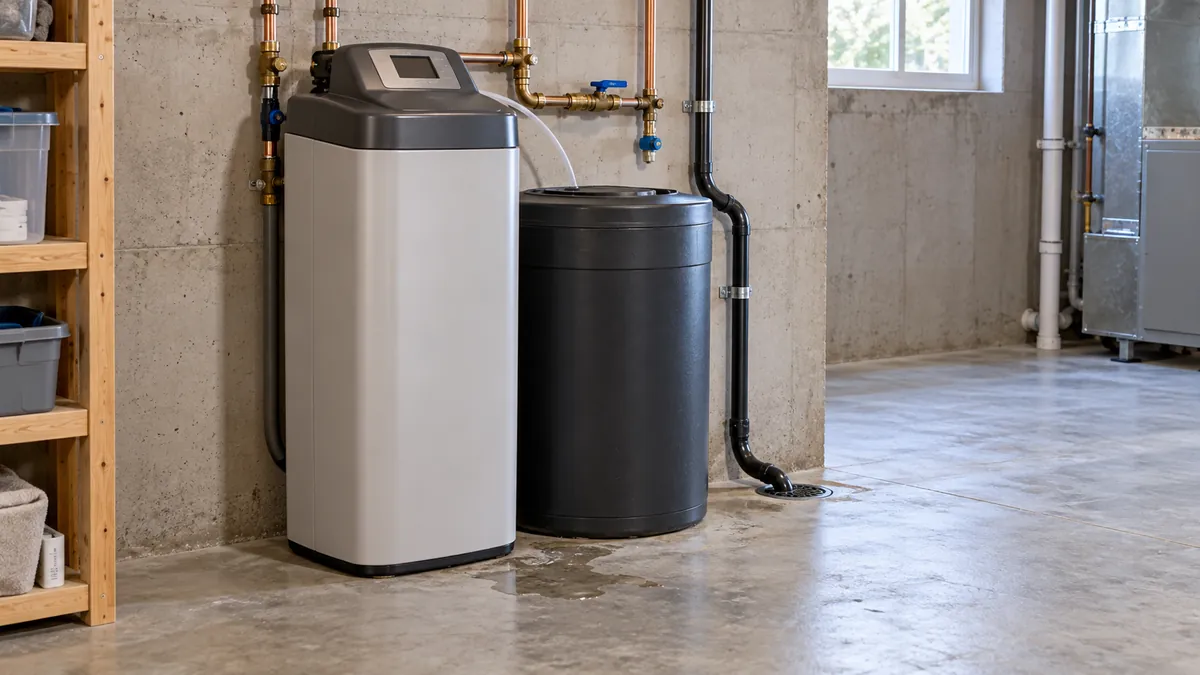
Water around a softener can appear at visible supply fittings, a drain line used during regeneration, or the cabinet or brine tank. A puddle’s position is not proof of which component failed because water follows slopes and seams. If water is spreading or close to electricity, keep clear and call the installer or a qualified plumber. Do not operate unfamiliar bypass valves or disconnect tubing to ‘test’ it.
Log position and operating timing
Write down the make and model, where water first became visible, whether the control panel shows a regeneration cycle, and whether the area remains wet between cycles. If safe from a dry location, photograph visible tubing paths and any drips; avoid touching electrical controls. A timed observation helps a technician select a test but cannot establish internal valve failure.
Three different paths
| First wet point or timing | What this could mean | Evidence to hand to service | When not to investigate further |
|---|---|---|---|
| Incoming or outgoing supply fitting, including while idle | Pressurized connection or water tracking down from above; not proof of a failed valve | Model, full tubing photo, idle versus in-use time | Spreading water, inaccessible shutoff or wet electrical parts |
| Visible drain route only around a scheduled regeneration | Intended discharge may be occurring, or the drain route may have an overflow or connection fault | Display or clock time, first wet spot, route of visible drain hose | Do not trigger another cycle or disconnect a drain to reproduce the leak |
| Brine tank, housing seam or cabinet floor | Possible overflow, seal or neighboring water source; surface location alone cannot identify the component | Tank fill appearance from outside, seam photo, recurrence | Do not open the unit, add chemicals or change bypass settings |
| Floor wet between cycles or close to a washer or water heater | Leak may originate outside the softener | Wide scene photo, dry-versus-wet boundaries, other appliances’ operating times | Stop observation when electricity, structural damage or uncontrolled flow is possible |
What EPA does and does not tell us
EPA WaterSense’s Free of Leaks technical sheet explicitly includes water softeners and drinking-water treatment equipment among devices whose visible water supply connections and valves should be checked. It does not supply a model-specific procedure to diagnose a softener’s resin tank, valve head, or regeneration circuit. Those checks belong in the manufacturer’s instructions and professional service.
EPA 2026 reference and a calculation—not a leak diagnosis: The U.S. EPA WaterSense water softener guide (May 2026) says a typical softener uses 20–70 gallons per regeneration cycle, while some larger systems can use up to 200 gallons. EPA says actual use and regeneration frequency vary with water hardness, household consumption, system capacity, and regeneration design. As an illustration, a system regenerating twice a week at the typical 20–70 gallon range would route 40–140 gallons through its intended regeneration process each week. This calculation uses EPA’s general typical range; it is not a measured household result, leak diagnosis, or allowable floor-leak volume. Water on the floor is not explained away as normal merely because regeneration uses water. Compare the model manual, cycle log, and first wet point; ask a qualified installer or plumber to check the intended drain route if water escapes it.
EPA evidence translated into a three-way service decision (desk review, not a field test): The EPA WaterSense softener guide (May 2026, maintenance section) notes that continuous water flow to a drain can indicate a valve or other malfunction. This does not establish that a particular household unit is leaking. Case A — discharge only during a known regeneration cycle, with a dry floor: record the cycle timing and compare it with the exact model manual; do not label ordinary drain discharge a leak. Case B — persistent or unexpected drain flow outside the expected cycle: note the observation from a safe location and contact the installer or qualified service professional; do not manipulate a valve or disconnect a hose to verify the cause. Case C — water escaping onto the floor, a shared drain backing up, or moisture near electrical parts: treat this as an escape or safety concern regardless of the cycle status, keep clear, and seek appropriate service. Our added value is separating the timing evidence, the water path, and the service decision; none of these observations proves an internal component fault without inspection.
The handoff checklist
- Photograph the full unit with nearby floor and drain.
- Record approximate start time and whether a cycle was indicated.
- Look for moisture at exposed joints only if safely accessible.
- If water spreads, isolate the area and contact the service provider; use a shutoff only if its purpose is positively known and it is safe to turn.
- Keep the model number and installation records for the technician.
Original comparison: a regeneration-time coincidence can mislead
The softener display and a puddle provide two different facts. A cycle coinciding with moisture is not an observation of water escaping the softener. This ledger adds a disconfirming question so the homeowner can avoid blaming the wrong appliance.
| Recorded observation | What remains uncertain | Best next evidence without dismantling equipment |
|---|---|---|
| Regeneration indicated at 02:00; floor found wet at 07:30 | The puddle may have appeared before, during, or after the cycle | Record the two times as separate facts; include any nearby water heater, washer, or floor drain in one wide photo. |
| Water visibly reaches the floor from a drain-hose outlet during an ordinary cycle | Hose arrangement, receiving drain condition, and model limits are not known | Stop use if leaking or unsafe; share a safe-location photo, model and manual with the installer or plumber. |
| A visible incoming supply fitting is wet when the unit is idle | Moisture may have traveled from a different fitting above it | Document the uppermost wet point without touching the joint; ask for pressurized-line inspection. |
| Another fixture or shared floor drain also backs up | The softener may not be the sole source | Report both fixtures and timing; request broader drain assessment before replacing a softener. |
Illustrative counterfactual: If the cycle log is unchanged but a laundry standpipe visibly overflows nearby, “regeneration caused the puddle” becomes weaker even if the softener’s drain hose is damp. This is a reasoning example, not a result from an installed unit. The only confirmed evidence is what the homeowner actually saw, not the part we guess needs replacement.
Illustrative comparison
Hypothetical, not an installation test: A utility-room puddle appears on three mornings after a scheduled regeneration. The drain hose is visibly wet, but a nearby washing machine shares the same floor drain. The homeowner records both sources and the time. The correct next step is a drain and equipment assessment, not immediately buying a new softener.
Model-specific service note: “Brand/model: ___; installed location: ___; first wet point: ___; regeneration scheduled or displayed at: ___; water present when idle: yes/no/unknown; visible supply fitting wet: ___; visible drain route wet: ___; nearby equipment sharing floor drain: ___.” Do not infer that a brine tank is leaking just because salt residue is visible; residue and water may have different causes. Include photographs and the installation manual so the technician can use the correct model procedure.
Do not confuse regeneration discharge with a leak: Some systems intentionally send water to a drain during regeneration, but water leaving its intended drain route and reaching the floor is not something to dismiss as normal. A drain hose that looks damp at one point may have been wetted by a different nearby pipe or a shared floor-drain backup. Record the model and cycle timing, then let a qualified technician distinguish normal discharge, connection failure, and drainage restriction.
Stop, sources, related reading
Do not remove pressurized connections, defeat an overflow, pour cleaning agents into the device, or assume bypassing is harmless. Seek service for repeated wetness, damaged fittings, electrical risk, or water behind walls. Sources: EPA WaterSense fixture and equipment leak checklist; EPA leak identification guidance. Compare laundry standpipe backup warning signs when multiple appliances share the room. Reviewed October 29, 2026; no firsthand unit test. To keep regeneration timing, first wet location, neighboring drain symptoms, and technician contact in one place, use the Home Leak Triage Worksheet; this is an observation record, not a valve-adjustment instruction.
Leave a Reply