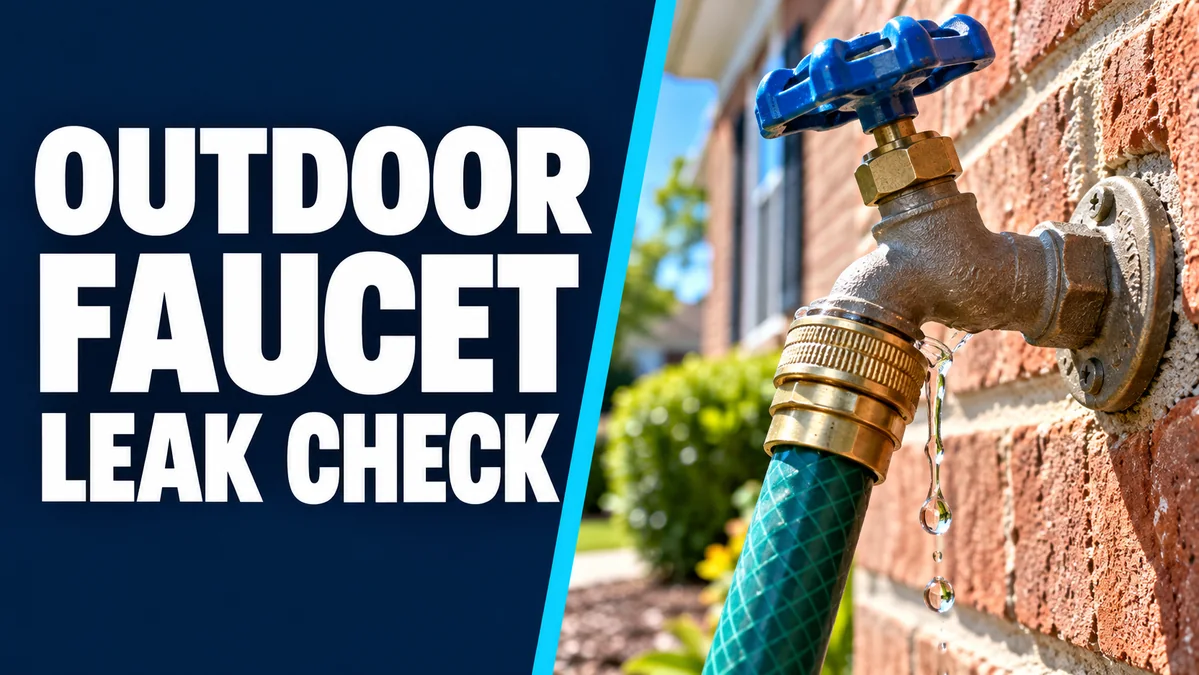
Quick answer: A drip at an outdoor hose bib is not always a failed wall pipe. If it is safe, stop using the faucet and observe from a dry position whether water is at the hose coupling, spout, handle stem, or wall penetration. Stop immediately if water appears to be entering the house; a damaged or seized shutoff is not something to operate to complete this check. Never force a corroded valve or perform a pressure test on a visibly damaged fitting.
This guide is intended for U.S. single-family homeowners and renters who can safely observe an accessible outdoor faucet. It does not teach pipe disassembly. Manufacturer instructions, local freeze protection requirements and lease rules take priority. Sources checked October 29, 2026.
1. Separate four leak locations
- At the garden hose thread: the hose washer or coupling may be worn, missing, cross-threaded, or poorly seated. EPA explicitly recommends checking outdoor garden-hose connections for leaks.
- At the end of the faucet while closed: an internal shutoff or seal may not close fully; a drip can occur even with the hose removed.
- At the handle/stem when turned on: a packing or stem seal may need a professional or manufacturer-specific repair.
- At siding, brick or the wall penetration: this is a higher-risk clue; water may be reaching wall cavities. Do not assume the exterior drip shows the full damage.
2. No-tools observation only while safe
- Take a photo of the initial condition and note the weather and whether the hose is attached.
- If the faucet handle is undamaged and moves normally, stop ordinary use; do not touch or force a seized, cracked, frozen, or actively spraying handle. Seek qualified help when a safe shutoff is unavailable.
- Check the hose coupling visually for a crooked connection or missing visible washer; do not touch a leaking electrical device nearby.
- Do not disconnect a hose solely to reproduce or locate an active leak. If the hose was already disconnected, record that condition; otherwise note it as connected or unknown.
- From a dry and safe position, note whether the spout continues to drip when the faucet should be off.
- Look for damp interior drywall or flooring directly behind the faucet if that space is readily accessible; do not open walls.
- Record whether the leak occurs only while the hose is attached, only while the faucet is on, or continuously.
- If water is seeping from the wall, use a safe accessible shutoff and contact a plumber promptly.
3. A location and timing decision table in plain English
| Observation | What it may suggest | Safer next action |
|---|---|---|
| Only at hose coupling during use | Hose washer/coupling may be source | Stop flow; inspect accessible hose end when depressurized |
| Drips from spout when faucet is off | Internal shutoff or valve issue possible | Record idle dripping; request repair assessment |
| At handle stem during use | Stem packing or valve body may be involved | Avoid tightening pressurized components |
| From wall penetration after a freeze | Hidden freeze damage cannot be ruled out | Stop use, alert owner/plumber, avoid forcing faucet |
Hose coupling + only when in use: first review washer fit and coupling condition; EPA recommends a hose washer and pipe tape where appropriate, but follow the product’s own instructions. Spout + faucet closed: do not blame the hose; the faucet shutoff needs inspection. Wall area + any time: escalate to a plumber because concealed water damage may develop. Winter freeze or sudden spray: isolate safely and ask for professional service.
Original fault-boundary map: hose-side versus house-side uncertainty
The most useful distinction is not simply ‘faucet leaking’ but whether the only observed wet point is at a removable hose connection or where water can enter the wall. Exterior and indoor observations must be kept separate; a dry wall seen from indoors is not proof that concealed piping is intact.
| Observed boundary | Competing explanation | What to document without another test |
|---|---|---|
| Water was seen at the hose coupling only during ordinary use; surrounding wall remained visibly dry | Hose end, washer, or coupling; faucet internals not proven faulty | Photo of coupling and whether hose was attached; report no house-side water was observed, not that none exists. |
| Closed spout continued to drip when the faucet was already off | Valve closure issue is possible; an attached hose cannot explain every spout drip | Existing photo or short observation from a dry position; whether the drip persisted without manipulating a stuck handle. |
| Damp trim or siding appeared near the wall penetration after freezing weather | Concealed split pipe or another exterior water path remains possible | Both exterior and accessible interior context photos without opening surfaces; stop use and request plumber/building assessment. |
| Inside wall or floor looks wet while the outdoor faucet is not in use | Another supply route, rain intrusion, or prior stored water may be involved | Location of interior moisture and time first noticed; no forced faucet operation. |
Copy-ready request: ‘First water seen at [hose/spout/stem/wall/interior/unknown]; faucet state [on/off/unknown]; hose state [connected/disconnected/unknown]; recent freeze [yes/no/unknown]; indoor wall observation [wet/dry/not checked].’ The table is an original classification aid, not a field-tested leak diagnosis.
4. Two examples with different outcomes
Hypothetical example A: A gardener sees drops only where the hose screws on, with a visibly dry wall and no further dripping once normal water use has stopped. That pattern supports checking the hose washer before replacing the wall faucet. Hypothetical example B: A resident sees damp trim around the faucet after a freeze, even when the hose is disconnected. The right decision is to stop using the connection, locate a safe water shutoff and call a plumber, not repeatedly turn it on to locate a hidden crack. These examples illustrate decision logic and are not firsthand field tests.
5. What to do if the water meter is moving
A continuously moving meter while household water use is off can be a clue of a leak, but irrigation systems, water treatment equipment or other automatic uses can confound the check. Follow your local utility’s meter guidance and compare it to our meter and toilet leak test. Never enter a hazardous meter vault or tamper with the utility’s equipment.
6. When DIY observation ends
- Water is entering the wall or interior, the faucet sprays uncontrollably, or a pipe may have frozen.
- The shutoff is inaccessible, damaged or seized.
- Electrical equipment or outlets are wet.
- The faucet belongs to a rental, condo or shared irrigation system requiring owner or licensed professional intervention.
- Leak persists after basic user-serviceable hose-connection checks.
Keep a four-line report
Record the location (coupling/spout/handle/wall), whether water was on or off, temperature/freeze history, and any safe shutoff action. Include a photo and the faucet or hose brand if known. This avoids conflating the hose washer with a concealed wall pipe.
Cold-weather decision gate: a hose drip is not a freeze-damaged wall pipe
Why this matters: A faucet can have a visible leak at its hose washer and a separate hidden freeze injury. Denver Water specifically advises disconnecting hoses so freeze-proof faucets can drain; it also warns that frozen pipes may break or release water when thawed. Do not use a summer hose-coupling observation as evidence that an exterior wall pipe survived a freeze. The following is an editorial triage table, not a tested diagnosis.
| History already known | What to record | Safe decision |
|---|---|---|
| No freeze exposure known; drip visibly confined to hose coupling during ordinary use | Hose attached, first wet location, whether wall is visibly dry | Document likely hose-side question, but do not certify concealed piping sound. |
| Hose remained attached during freezing weather, regardless of where water is visible | Approximate freeze dates and whether the hose was attached | Do not turn the faucet on for testing; ask a qualified plumber whether frost damage needs inspection. |
| Water appears at interior wall, trim, or flooring after a freeze or thaw | First interior wet point and photos from a dry position | Prioritize safe shutoff and prompt professional assessment; do not open the wall or run flow tests. |
| Valve is seized, cracked or shutoff cannot be reached safely | Accessible contact/owner information; no forced operation | Stop DIY checks and arrange qualified isolation and repair. |
Source boundary: Denver Water’s Cold Weather Tips supports hose disconnection, shutoff awareness and freeze risk. The specific four-row sorting method above is our editorial synthesis. It does not imply we inspected a frozen faucet. Reviewed November 7, 2026.
Official sources and limits
The U.S. EPA WaterSense Fix a Leak Week guide specifically addresses outdoor garden-hose coupling leaks and the role of a hose washer. The observation categories and hypothetical scenarios above are editorial tools, not evidence that a homeowner can locate concealed damage without inspection. The inspection categories above are our interpretation of where to observe and when to escalate; they are not a field-tested diagnosis. No outdoor fixture was personally inspected for this article.
Continue with these related checks
If the leak may be inside a wall or under another fixture, do not assume the outdoor faucet is the source. Document where water first appeared and ask a qualified plumber to assess the concealed path; do not cut into the wall to investigate. If the home-side shutoff itself is wet, review safe main shutoff leak checks and contact a qualified plumber rather than forcing a valve.
Editorial review: November 7, 2026. Informational only; no guarantee of diagnosis or repair.
If the faucet area is safe and dry, use the Home Leak Triage Worksheet to note whether the first drip appeared at the hose coupling, spout, handle, or wall and when it happened. Do not disassemble the faucet or repeat a risky test.
Leave a Reply