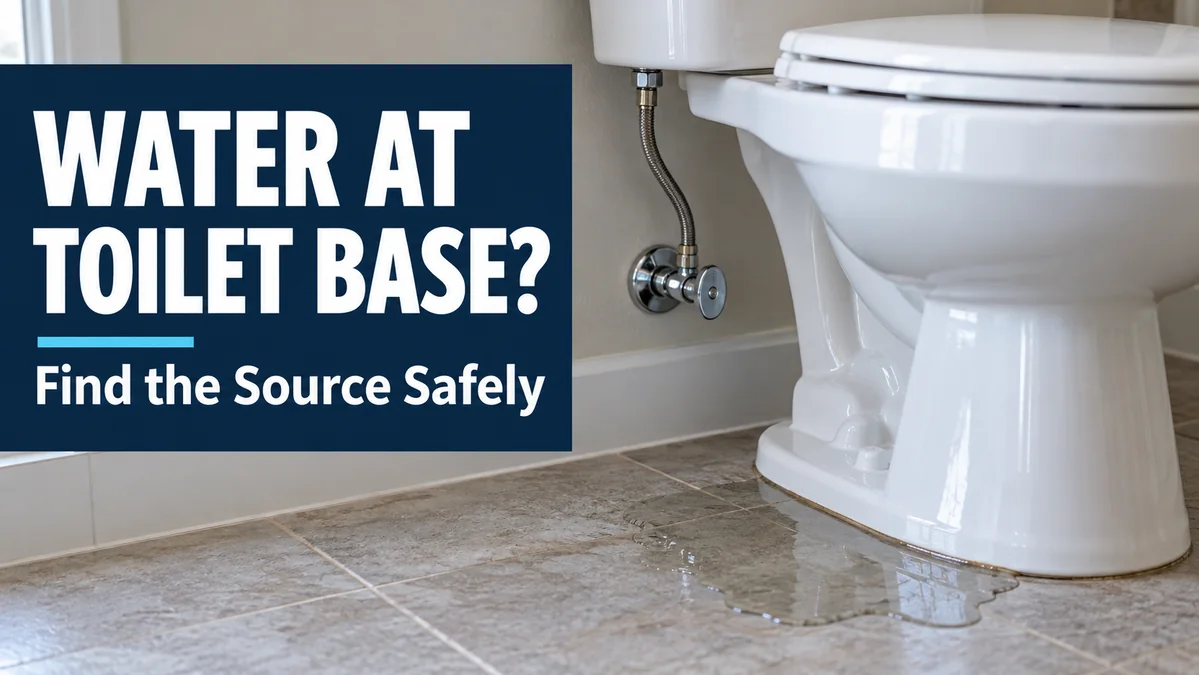
Quick answer: A puddle beside a toilet can come from condensation on the tank, a supply connection, a tank-to-bowl joint, or water escaping near the bowl’s floor seal. The most useful first clue is when the water returns and where it first appears. A wet floor alone cannot identify the failed part. If water is visibly escaping, stop using the toilet and arrange a qualified inspection.
Start with safety and timing
Keep children and pets away. Do not touch an outlet, cord, appliance, or electrical panel if it may be wet. If water is spreading quickly, coming through a ceiling, or may contain sewage, leave the affected area and contact the appropriate emergency or building professional. Renters should notify the landlord or property manager promptly and follow the lease’s reporting procedure.
Before cleaning the area, if it is safe, take a photo and note when it was last dry. Record whether the toilet had just been flushed, whether the tank exterior felt damp across a broad area, and whether the supply connector or valve looked wet. These observations help distinguish patterns; they do not confirm a diagnosis.
What the timing may suggest
| Pattern you observe | Possible source to discuss | Next step |
|---|---|---|
| Moisture beads broadly over the cold tank, especially in humid weather | Tank condensation is possible | Dry the outside and note room conditions. If water continues to collect at the floor, investigate further rather than assuming condensation. |
| A small wet point starts at the supply line or shutoff, whether or not the toilet is flushed | Supply hose, valve, or connection | Do not tighten or force the valve. If it keeps leaking, stop using the fixture and contact a plumber or building manager. |
| Water runs down from the tank after a flush | Tank bolt, tank-to-bowl gasket, or a crack may be involved | Do not remove the tank. Photograph the visible path and request service. |
| Water first appears at the bowl’s floor edge during or soon after flushing | The bowl-to-floor seal or another concealed connection is possible | Stop flushing and arrange an inspection. The exact cause cannot be confirmed from the puddle alone. |
| Water appears after splashing, mopping, or a child’s bath routine | Surface water may have traveled to the base | Dry the area and record what was happening; check whether moisture returns without that activity. |
A three-zone observation check
Use this only when there is no active flow, electrical concern, sewage, or other hazard. Do not pull the toilet, open a wall, remove the tank, or loosen any fitting.
- Record the starting condition. Photograph the dry floor and visible parts. Note the time and the last known dry period.
- Separate the visible areas. If safely accessible, place small pieces of dry paper towel near the supply connection, behind the tank, and beside the bowl base. Keep them away from electrical devices.
- Observe without touching plumbing. Note which area becomes damp first and whether this occurs with the toilet unused or after ordinary use. If you already know that flushing makes water appear at the base, do not flush again to reproduce it.
- Stop when the pattern is clear or risk increases. Remove the towels, take a photo, and share the timing and location with the plumber or property manager. One dry check does not rule out an intermittent leak.
How to interpret the result without overdiagnosing
A supply-side drip can happen even when the toilet is not being flushed. A floor-seal problem is more concerning when water appears at the base in connection with flushing, but other paths can imitate that pattern. Water can track along porcelain, flooring, or the underside of a fixture before it becomes visible. American Standard’s toilet troubleshooting guidance likewise directs readers to check the base and tank and notes that a floor-seal repair may be needed when the base is leaking and no crack is visible. That is a reason to request inspection, not proof that every puddle means the seal has failed.
Do not tighten the floor bolts or rock the toilet to “test” it. Porcelain can crack, and movement can worsen a seal or hidden leak. A plumber can inspect the bowl, connections, and floor flange safely and determine whether repair or replacement is needed.
Worked comparison (illustrative, not a site visit): In Apartment A, droplets cover much of a cold toilet tank on a humid morning and no concentrated drip is visible. In Apartment B, water appears on the floor again immediately after flushing near a loose-feeling toilet. A may warrant a moisture/condensation assessment; B warrants stopping use and arranging a plumbing inspection. Neither pattern proves a diagnosis, and a toilet should not be rocked or its bolts tightened as a test.
Evidence boundary: a running toilet is not the same as water on the floor. Kohler’s manufacturer troubleshooting guide describes a toilet that periodically refills because water escapes from the tank into the bowl. That symptom may occur without any external puddle. Our source-to-action distinction is therefore: (1) running/refilling sound with a dry floor → document an internal tank-to-bowl water-loss question and use the separate silent-toilet-leak guide; (2) new moisture at an external supply connection → photograph the visible connection without tightening it; (3) water at the toilet base during or after flushing → stop using the fixture and ask a plumber to assess the seal, fixture, and surrounding drainage. A dye result can suggest an internal toilet leak; it cannot prove or rule out a floor-seal failure. This comparison is based on published manufacturer guidance and observation logic, not an actual toilet inspection; the Kohler explanation is not a universal diagnosis for every toilet model.
Original evidence hierarchy: the toilet-base puddle is not the origin
A ring of water near a toilet base can make a floor seal seem certain even when water may have traveled down the tank, supply connector, or porcelain. Distinguish a directly seen path from an inference, and classify possible contamination before deciding whether to continue observing.
| Strength of evidence | Safe observation already available | What it supports | Escalation or limitation |
|---|---|---|---|
| Direct path | Visible drip starts at supply connector and travels down toward floor | Supply-side issue deserves inspection | Do not tighten a valve or fitting under pressure; photograph from a dry position. |
| Direct path | Water visibly tracks from the tank-to-bowl region after normal use | Upper-fixture route deserves attention | Do not remove tank or overtighten bolts; arrange model-specific service. |
| Location only | Puddle appears at bowl floor edge but no water path was seen | Source remains unknown; floor seal is only one explanation | Stop use if recurring after flushing; arrange qualified inspection without repeating flushes. |
| Possible wastewater hazard | Foul water, floor movement, soft flooring, or moisture in room below | Potential sanitation or building-damage risk | Keep away from affected water, stop use and escalate promptly. |
Copy-ready handoff: ‘First wet point [observed at connection/upper tank/bowl edge/unknown]; last known dry [ ]; flush association [already observed/unknown]; floor condition [firm/soft/unknown]; wastewater suspected [yes/no/unknown].’ These are reporting categories, not a site-visited finding or a diagnosis of a wax ring.
Stop using it and get help when
- Water reappears at the base during or after flushing.
- The toilet rocks, the floor feels soft, or a stain is spreading into another room or ceiling.
- A visible crack, continuous leak, stuck valve, or damaged connector is present.
- Water may have reached electrical equipment or the leak may involve sewage.
- You cannot identify the source without moving the toilet or opening building materials.
What to tell the plumber or property manager
Share four facts: where the first damp spot appeared; when it appeared relative to flushing; whether the supply connection or tank was wet; and whether the toilet or nearby floor moves, smells, or feels soft. Add dated photos and say what you did not test. This prevents a guess from being mistaken for a confirmed finding and helps the next person choose an appropriate inspection.
Related leak guides
For a toilet that runs without a puddle, see toilet tank-to-bowl leak clues. If the water bill rose, start with the meter and household leak check. For an active water leak, follow utility or plumber guidance; if the main valve itself is wet, review main shutoff valve leak signs.
Sources and scope
American Standard: What should I do if my toilet leaks water onto the floor? — manufacturer troubleshooting guidance. U.S. EPA: A Brief Guide to Mold, Moisture and Your Home — moisture control and drying guidance. Sources checked October 29, 2026. This article synthesizes those references into a visual observation workflow; no in-home inspection, repair, or physical test was performed. Toilet designs, building conditions, and local service responsibilities vary.
For a toilet-base concern, the Home Leak Triage Worksheet can organize the first damp location and its timing relative to flushing. It is a record for a plumber or property manager, not a test of the floor seal.
Editorial decision aid: four patterns that can look like a toilet base leak
These are hypothetical comparisons, not inspection results. The distinguishing question is whether the first visible moisture appeared on an accessible supply fitting, the tank exterior, the tank-to-bowl joint, or on the floor after a flush. Water can travel, so none of these clues proves a failed part.
| Observed pattern | What it helps rule in or out | Safe evidence to retain | Next step |
|---|---|---|---|
| Tank exterior is damp on humid days before flushing | Condensation is plausible; the floor seal is not established as the source | Time, room humidity if known, photograph from a safe location | Compare with meter-use clues; ask a qualified professional if recurrent |
| Water first appears at an accessible tank supply coupling or wall valve even without flushing | External pressurized supply route warrants inspection, not an automatic floor-seal diagnosis | Highest visible wet point and whether the toilet was in use | Read supply-line location checks; do not tighten a leaking pressurized joint |
| Moisture appears beneath tank after a flush | Tank-to-bowl seal or bolt area is a different candidate from the floor connection | Photo and observed time relative to the flush, without repeating a leak test | Ask service to check tank-to-bowl fittings |
| Water is noticed at the bowl base after a flush | A floor connection problem is possible, but traveling water, cleaning water and nearby pipes remain alternatives | First noticed time, neighboring wet points, sewage odor or floor damage | Stop use if leaking and arrange a plumber’s assessment; do not lift the toilet yourself |
Why this comparison is original: it applies the same first-wet-point and time-of-event questions across four visually similar symptoms and states where the inference stops. The EPA’s toilet guidance describes a tank-to-bowl dye test for silent internal leaks; a positive dye test is not evidence that water on the bathroom floor came through the toilet’s floor seal. No dye test, home visit or repair was carried out for this comparison. Source review: November 13, 2026.
Leave a Reply