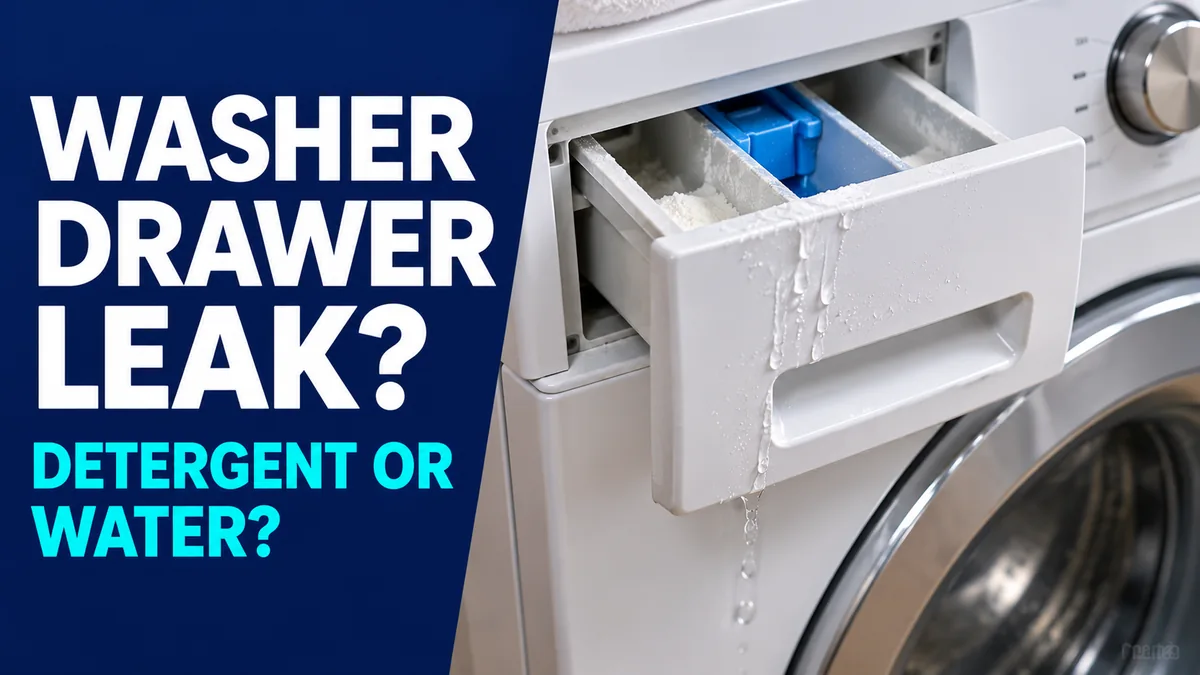
If water leaks from the detergent drawer of a front-load washer, do not immediately assume the water inlet hose or door seal has failed. A wet drawer edge, visible detergent buildup, and a recent change in detergent are useful clues, not a diagnosis. LG and Samsung both identify detergent residue, the wrong detergent type, or excessive detergent as possible contributors to dispenser leaks. Stop a leaking cycle safely, keep clear of wet electrical equipment, and only inspect accessible surfaces after the machine is idle and safe to approach. This guide is for U.S. households with a front-load washer; exact dispenser layouts and service steps depend on the model.
What makes a detergent-drawer leak different?
The dispenser drawer routes water and laundry products toward the drum. In some machines detergent buildup can restrict that path; excess foam can also show up elsewhere on the washer. The first visible wet point, cycle phase, detergent used, and residue pattern help you explain the fault to the manufacturer without forcing a diagnosis. Water collecting on the floor is not enough to establish which component leaked.
First-wet-point × detergent-history decision matrix
Use the clues to decide what to check next. The table can help narrow the next step, but cleaning and service instructions depend on the washer model.
| Observed pattern | Evidence to record safely | Reasonable next action | What it cannot establish |
|---|---|---|---|
| Water begins at the front or underside of the detergent drawer during filling | First wet drawer edge, detergent residue, product used, whether recently changed | Stop safely; check the model manual for accessible drawer cleaning and detergent instructions; contact service if damage or recurrence | That the water-inlet valve or an internal hose has failed |
| Thick foam or suds appears near the drawer, door, or rear | HE versus non-HE detergent; labeled dosage and machine drawer MAX mark; foam visible before stopping | Use only manufacturer-approved HE detergent and the appropriate amount on future loads; follow manufacturer advice about residue removal | That foam always originates at the drawer or proves a drain blockage |
| Liquid/powder residue remains packed in the dispenser after use | Clumps, hardened product, blocked visible channels; drawer seating condition when idle | Clean only removable parts in the manner specified by the exact model manual, then reassemble correctly | That a faulty pump or plumbing repair is needed |
| Water is first seen at the rear tap or inlet connection, with a dry drawer front | Rear first-wet location if visible without moving the washer | Consult the separate inlet-hose guidance or a qualified service provider | That the drawer caused the water on the floor |
| Leak continues after suitable detergent and accessible cleaning, or drawer is cracked | Photo of damage, model and serial details, time and previous safe actions | Stop using and request model-specific professional service | That more detergent, force or DIY sealant will repair it |
LG and Samsung: what the official instructions support
LG’s September 8, 2026 U.S. help article explains that excess detergent, non-HE detergents and thick detergent can create problems, and that residue buildup may restrict dispenser water flow. It recommends HE detergent, respecting the MAX fill indication, and cleaning the dispenser according to model instructions. Some LG details—for example, dilution of particular concentrated products and specific drawer geometry—are model- and detergent-dependent, not universal steps. LG: How to fix leaks from the detergent dispenser.
Samsung’s U.S. washer-leak troubleshooting says that when a leak occurs directly from a detergent drawer, the owner should verify HE detergent, reduce excess product, clean the drawer and check its cover where present. A continued leak calls for service. Samsung also discusses residue after over-sudsing; those cleaning procedures are not instructions to run a machine that is actively leaking near electricity. Samsung: Washing machine is leaking.
Samsung’s separate detergent-use guidance notes that exceeding the drawer’s MAX mark can contribute to appliance problems including leaks. An amount printed on one washer or detergent bottle must not be treated as a universal dosage for every model, load and water condition. Samsung: How to use detergent in your washing machine.
Safe, repeatable record — no leak-provoking restart
- Stop and assess safety: if active water approaches outlets, cords, controls or standing water near the machine, do not touch a wet plug or reach behind it. Keep away and seek appropriate qualified help. Do not move a connected washer.
- Record the first wet spot: drawer lip, beneath the drawer, door edge, pump-filter flap, rear hose or uncertain. Photograph only from a dry, safe position.
- Record timing: initial filling, rinse, drain/spin, or only after the drawer was opened. If you did not observe the onset, mark it unknown; never rerun a damaging cycle to find out.
- Check product history: note detergent brand/type, whether clearly labeled HE, any recent change, visible foam, and whether the dispenser was over its marked MAX line. Do not guess a measured dose if none was recorded.
- Inspect only accessible, idle equipment: if safe and allowed by the exact manual, check for visible residue or an obviously mis-seated drawer. Follow the manual before removing any inserts. Never pry a fixed dispenser or open a powered panel.
- Decide next help: if you identify visible damage, continuing leakage or uncertain safety, stop use and share the record with manufacturer service or a qualified appliance technician.
Two examples: residue at the drawer and water at the inlet
Example A — residue by the drawer: A front-loader drips from the drawer during filling after the household switches to a thicker detergent. Hardened detergent is visible in the accessible drawer once the washer is idle. Check the detergent label, the model’s dosage instructions, and the approved cleaning steps before considering a service call; these clues alone do not prove that an inlet valve has failed.
Example B — water at the rear connection: If the rear supply connection is wet while the drawer and front panel are dry, follow the inlet-hose first-wet-point guide or arrange service. Cleaning the drawer would not address a leak at that connection.
Three mistakes that can worsen an otherwise simple problem
1. Treating an overfilled MAX compartment as a leak diagnosis: MAX marks and detergent recommendations matter, but they do not prove which internal component failed. Use the correct manufacturer instructions, not a generic capful estimate.
2. Running repeated tests while water is spreading: even if a manufacturer suggests a cleaning or test cycle for a safe, non-leaking washer, do not deliberately rerun an actively leaking machine to photograph a fault. Document the existing evidence and seek service.
3. Mixing cleaning chemicals: do not mix bleach, vinegar, ammonia, detergent concentrates or other household chemicals. Use only the cleaner and procedures allowed by the model’s care instructions.
Send a better service report
| Evidence field | What to enter |
|---|---|
| Model and washer type | Exact manufacturer/model if safely readable; front-load / unknown |
| First wet location | Drawer edge / front panel / rear inlet / lower flap / unknown |
| Timing | Fill / rinse / drain / after opening / unknown |
| Detergent and MAX mark | HE label known? detergent changed? overfill observed? unknown |
| Visible condition | Residue, crack, misalignment, suds, no visible finding |
| Safety and actions | Active water/electrical hazard? stopped? cleaned only as manual directs? |
Suggested message: “My front-load washer [model] showed water first at [location] during [observed phase/unknown]. I noticed [visible residue/suds/damage/none]. The detergent was [HE type/unknown]. I stopped using the machine and have not repeated the leak. What model-specific inspection or service is appropriate?”
Related leak guides: different sources need different records
If water appears at the closed washer door or gasket, our door-leak guide distinguishes a true closed-door leak from residual drops after opening. For a wet pump-filter access flap after cleaning, see the two-cap guide. If a laundry drain standpipe overflows, that is a different drainage question.
Editorial method and source scope
Reviewed November 16, 2026 (United States). We compared LG and Samsung instructions and organized their guidance into the location-and-detergent checklist above. It helps you report what you observe; it cannot identify a failed internal part. Models differ, so follow the exact manual. For corrections, use our contact page; our source standards explain how we check published information.